
Dec 18th 2025
Updated August 18, 2026 · by Jon Hauptman
Car Holsters. Real Testing, Real Results, and the Real Safety Risks

We’ve done the testing. “Car holsters” consistently overlook important vehicle and firearms safety considerations. In terms of mounting solutions, retention, crash-worthiness, and occupant safety, most of the popular car holsters you’ll find for sale fail on more than one of these counts. We don’t produce or sell car holsters, so we can tell you the unvarnished truth about them.
These products look convenient. They also create real safety risks. They turn guns into loose objects inside a dynamic crash environment. They increase handling, reduce control, and can launch firearms across the cabin when airbags deploy.
We bought a sacrificial car, installed every type of car holster we could find, and tested them through rough driving, airbag deployments, and rollover simulation. This article explains what we saw and why on-body carry remains the safest option inside a vehicle.
Why People Choose Car Holsters
These products remain popular because many people believe:
- Appendix carry under a seatbelt feels uncomfortable or unsafe.
- Access to an on-body gun is slower while seated.
- A visible mounted gun looks tactical and appealing.
- If these are sold widely, there must be testing or standards behind them.
There is no crash-testing standard for car holsters. No automotive rating. No retention testing under impact. Most of these items are simple gadgets held by screws or adhesive stuck to thin interior plastic.
What These Products Actually Are
When we bought the typical car holsters online, we received:
- Magnetic mounts for the plastic beneath the steering column.
- Cupholder holsters that replace your drink holder.
- Velcro pouches for random plastic surfaces.
- Generic nylon and plastic holsters with drywall screws and vague instructions.
Almost none of these products mention:
- Airbag deployment zones.
- Seatbelt pre-tensioner forces.
- Crash loads.
- Structural mounting surfaces.
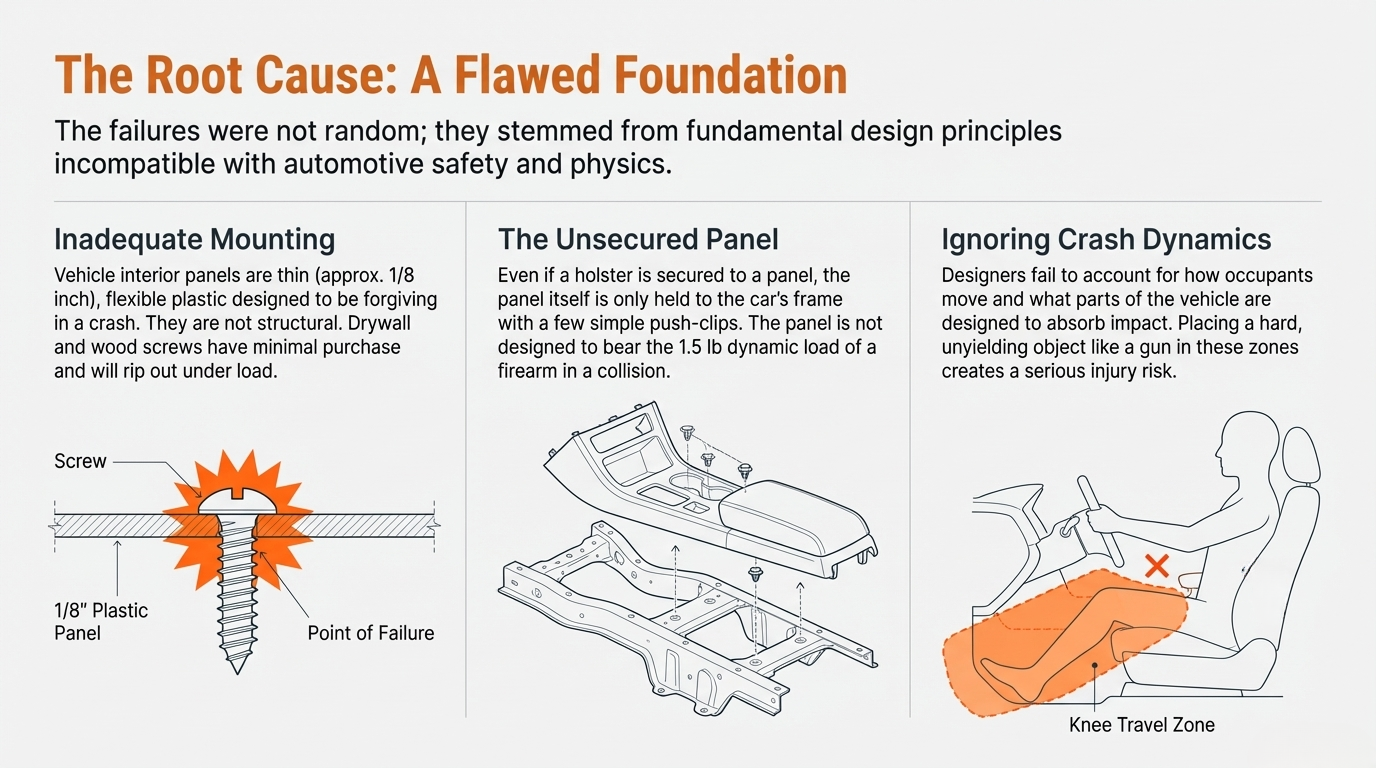
The interior of a car is not a uniform mounting surface. Panels are thin. They are designed to flex or break in a crash. They are not designed to hold a loaded firearm under impact.
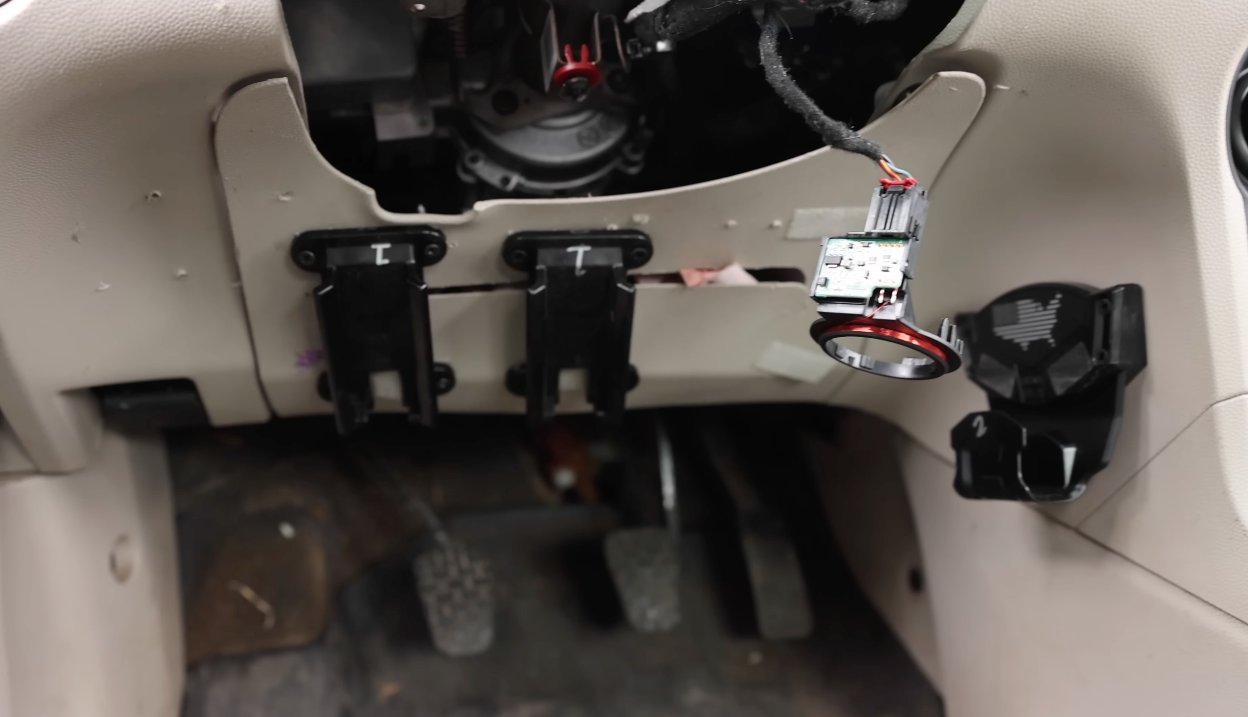
How We Tested
We installed multiple car holsters in a Ford Fiesta in the common recommended locations. Then we ran controlled tests:
- Rough driving and hard braking.
- Seatbelt pre-tensioner activation with an appendix holster.
- Airbag deployment using a true-weight blue gun.
- Rollover simulation using a tractor.
For every test we asked:
- Does the gun stay in place.
- Does the mount stay attached.
- Does anything become a projectile.
- Is this safer than on-body carry.
Test 1. Rough Driving and Hard Braking
The first test required no crash. Only bumps, ruts, speed, and quick braking. Guns began to move almost immediately.
- Holsters lost guns during normal vibration.
- Cupholder rigs tipped, letting guns rotate or shift.
- Magnets and Velcro allowed guns to slide.
A gun that moves under normal driving can end up in the footwell or under the seat. Both create new risks. If a setup fails during mild driving, it cannot be trusted in a high-force collision.
Test 2. Seatbelt Pre-Tensioner vs On-Body Appendix Carry
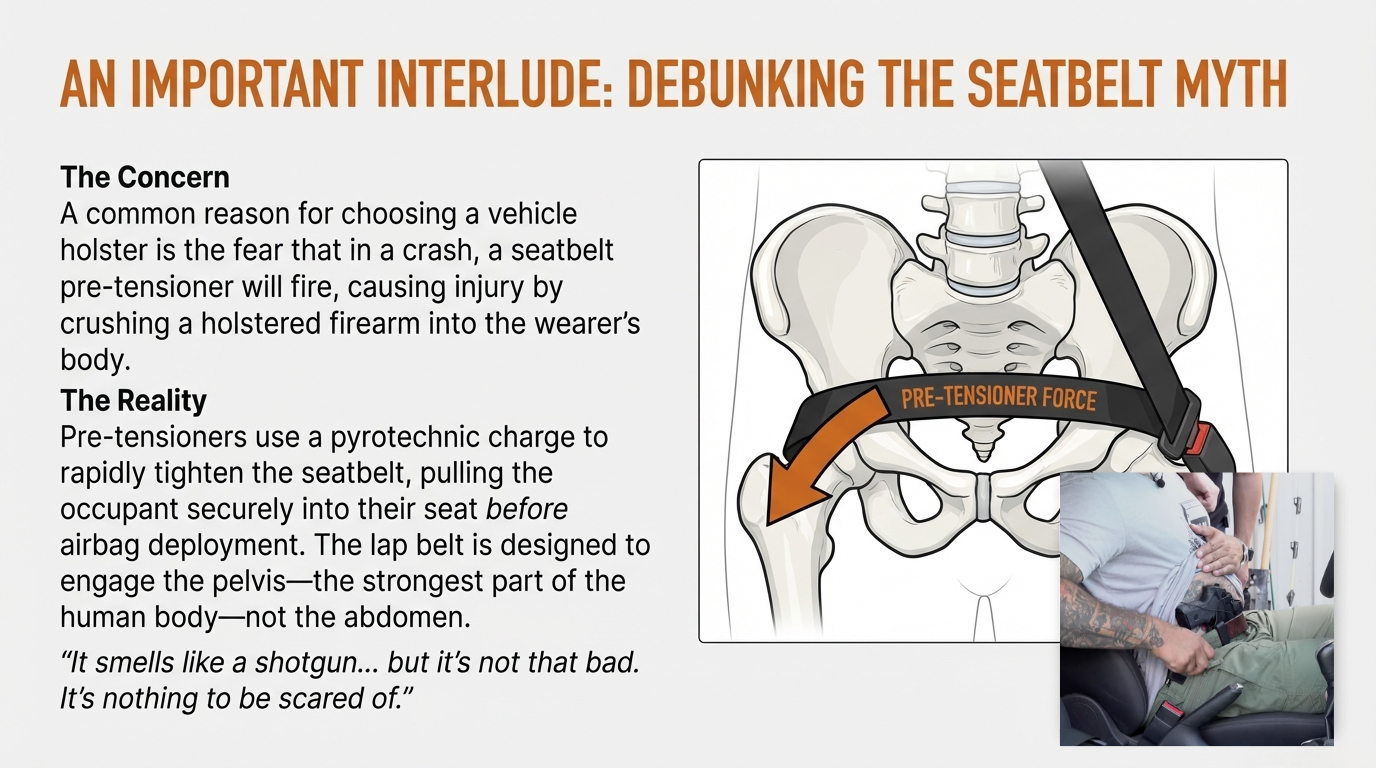
Many gun owners worry that a seatbelt will crush an appendix-carried gun into the abdomen during a crash. We tested this directly.
What happened:
- The pre-tensioner activated and tightened across the torso as designed.
- The appendix holster did not shift or damage the carrier.
- Discomfort occurred on the chest, not at the holster.
Seatbelts are engineered to restrain your body. They are not designed to work with loose objects mounted in the cabin.
Test 3. Airbag Deployment and Car Holsters
We placed a various pistols in common car holster locations and deployed airbags.
Results:
- The airbag launched the gun across the cabin instantly.
- Plastic panels cracked or ripped free.
- Screws bent or tore out of thin plastic.
- Guns and magazines separated during impact.
Anything between an airbag and the occupant becomes a projectile. Airbags deploy with explosive force. They do not move slowly or gently.

Test 4. Rollover Simulation
We rolled the car using a tractor to see how car holsters behave during rotation and impact.
What we observed:
- Holsters that remained attached earlier finally failed completely.
- Guns left holsters during rotation and bouncing.
- Magazines separated and hardware detached.
A rollover creates multiple impacts. Everything moves. A firearm mounted to trim or a cupholder does not stay in place.
Why Loose Guns in Cars Are Dangerous
A gun that leaves its holster during a crash can create four major risks.
- Projectile risk. A gun or holster can strike occupants at high speed.
- Uncontrolled access after a crash. The gun may land under a seat or near a child.
- Confusion when you need control. Injured or disoriented occupants may not know where the gun went.
- Increased administrative handling. Moving the gun between two holsters increases the chance of a negligent discharge.
On-Body Carry vs Car Holsters
On-body carry keeps the gun attached to you. The restraint system is engineered to protect you. This allows predictable retention and control during a crash.
Car holsters attach firearms to surfaces not designed to retain weight or resist crash forces. They often sit in the path of airbags or in places where knees or legs will impact.
On-body carry is more stable. Car holsters fail under real forces.
Safety Rules for Carrying Inside a Vehicle
- Do not mount a firearm to thin interior plastic.
- Never place a gun in the path of any airbag.
- Do not trust magnets, Velcro, or cupholder rigs for crash retention.
- Avoid products with no crash-testing or engineering data.
- Minimize handling. Avoid moving the gun on and off your body inside the car.
- Carry on your body in a quality holster that protects the trigger and retains the firearm.
What To Do Instead
We are not telling you to stop carrying in the car. We are telling you to use the safest method.
- Carry on your body with a quality holster.
- Adjust your seat, belt positioning, and clothing for comfort.
- Understand how restraint systems work with your body and equipment.
We tested these products to show what really happens in a crash. A firearm belongs on your body, not mounted to the interior of your vehicle.
Your gun should stay attached to you, not your dashboard.