
Why Your Sidecar Holster Doesn't Conceal (and What Actually Works)
Posted by Jon Hauptman on May 7th 2026
"Sidecar" has become a generic term for any appendix carry holster which has a conjoined or attached magazine carrier. This style of holster has become quite popular over the past decade or so, but we don't offer that configuration here at PHLster. If you've struggled with comfort and concealment when using a sidecar-style holster, this blog will explain exactly why that is.
Where the sidecar holster came from
The first ever mainstream product in this category was the G-Code Incog. Designed in collaboration with Travis Haley over ten years ago, the Incog had a small protruding attachment tab on the sight channel side of the holster which allowed a magazine carrier to be optionally attached. Since this was only a few years after the Magpul Dynamics videos came out, there was nothing cooler than Travis Haley's signature appendix carry holster. Small shops and holster DIYers quickly jumped on the Incog train, once there was a backlog of orders and a hefty wait time.
G-Code was manufacturing the Incog with vacuum forming and CNC trimming, which allowed them to implement the protruding mag attachment tab. But DIYers and small shops didn't have access to that technology quite yet. So, what did they do? They put a magazine and a pistol in their foam holster press, together at the same time, and squashed the Kydex around both objects. And the sidecar holster was born.
Why the first sidecars broke a lot
The first generation of sidecar holster was a monolithic, wide, inflexible, single piece of Kydex. They had to be curved somewhat in an attempt to conform to the wearer's body. But that curve was a fixed angle, since it was all one rigid piece of Kydex.
These designs broke frequently. As you know, a holster wing is an attachment which uses belt pressure to rotate the grip of the pistol inward to the body to aid in concealment. When an entire pistol magazine is rigidly attached to the opposite side of the holster, it has the effect of being a much bigger wing. So, tightening the belt pushes the magazine into the body and counteracts the effects of the holster wing. This stressed the sidecar style holster and resulted in frequent breakages.
The next evolution: flexible magazine attachments
It wasn't long before the obvious evolution of the sidecar style holster took shape: flexible magazine attachment. These days, there are about as many different flexible joint mechanisms as there are brands of sidecar holster. Tegris, biothane webbing, shock cord, and even mechanical hinges are being used to help reduce breakage frequency, improve ergonomics, and tame the opposing forces acting against concealment.
But, despite all that, you're still uncomfortable and the grip of your pistol is printing through your shirt. It doesn't matter how flexible that attachment is, if you're just the wrong shape and size to fit the holster.
Why you're still uncomfortable: it's a body fit problem
Let me backtrack a little bit here. As the owner of PHLster, I've been making holsters and custom-fitting them to customers since 2010. Back when I was working by myself in my tiny shop, I had an in-person appointment for custom work nearly every day. During that appointment, the final step was always tweaking the holster to fit that specific person. That included adjustments to the holster itself, but it also involved optimizing the holster placement on their body.
Specifically, teaching the customer about how the holster interacts with their body, the forces which generate concealment, and the degree to which holster placement relative to their body contours work with or against those forces. These in-person sessions were the genesis of the vocabulary we currently use to teach Concealment Mechanics online: Concealment Sweet Spot, Peaks and Valleys, and Poke and Check. Being able to locate the holster on the part of the abdomen where the concealment mechanics can have the maximum effect, and where comfort is most likely to take place, are essential to concealed carry success.
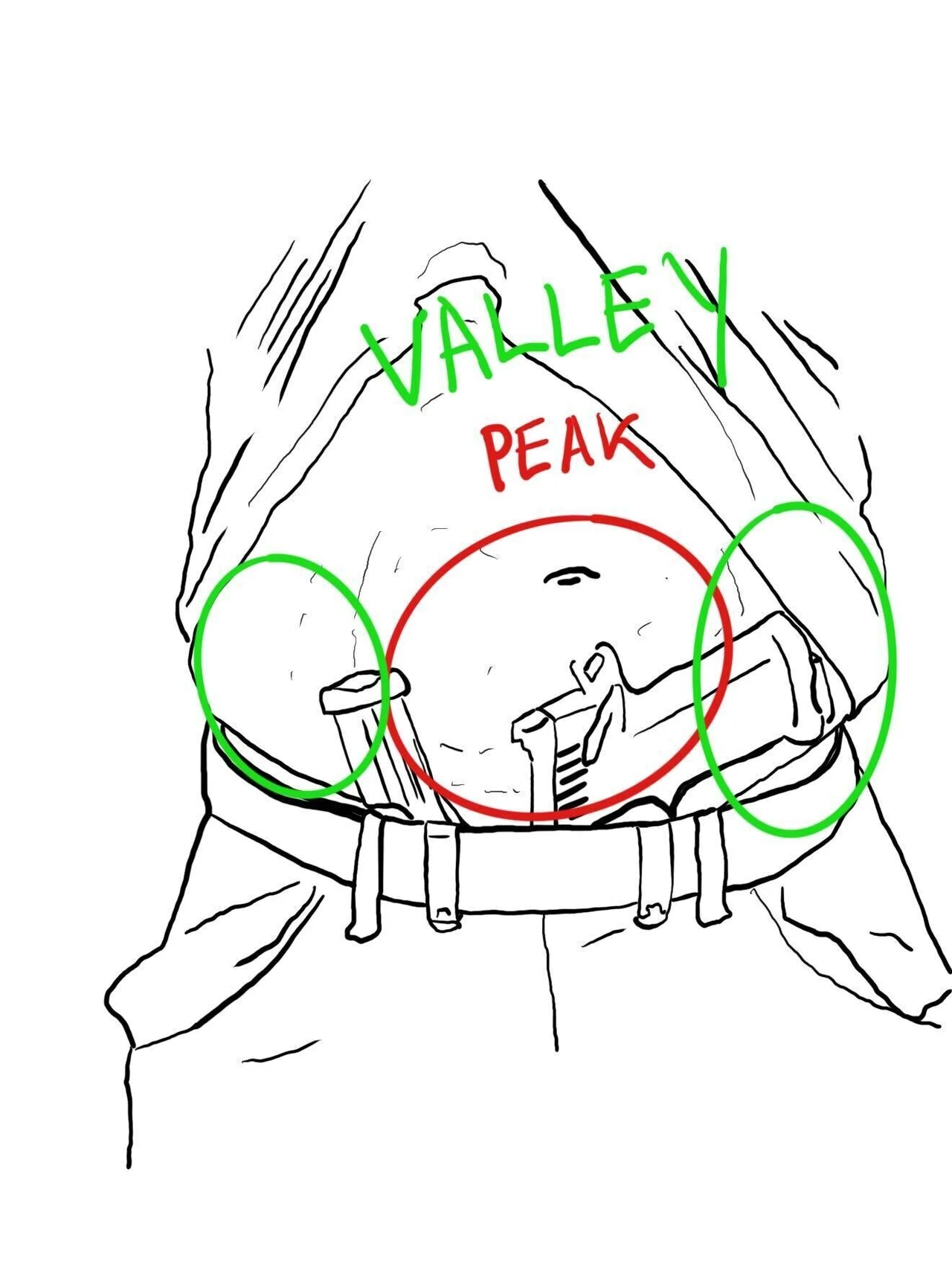
And this is why you're struggling to achieve comfort and concealment with a sidecar-style holster. The inherent design of the holster dictates a very limited range of placement on the body. That is, the center of the rig has to be exactly front and center on your body, regardless of how you're shaped.
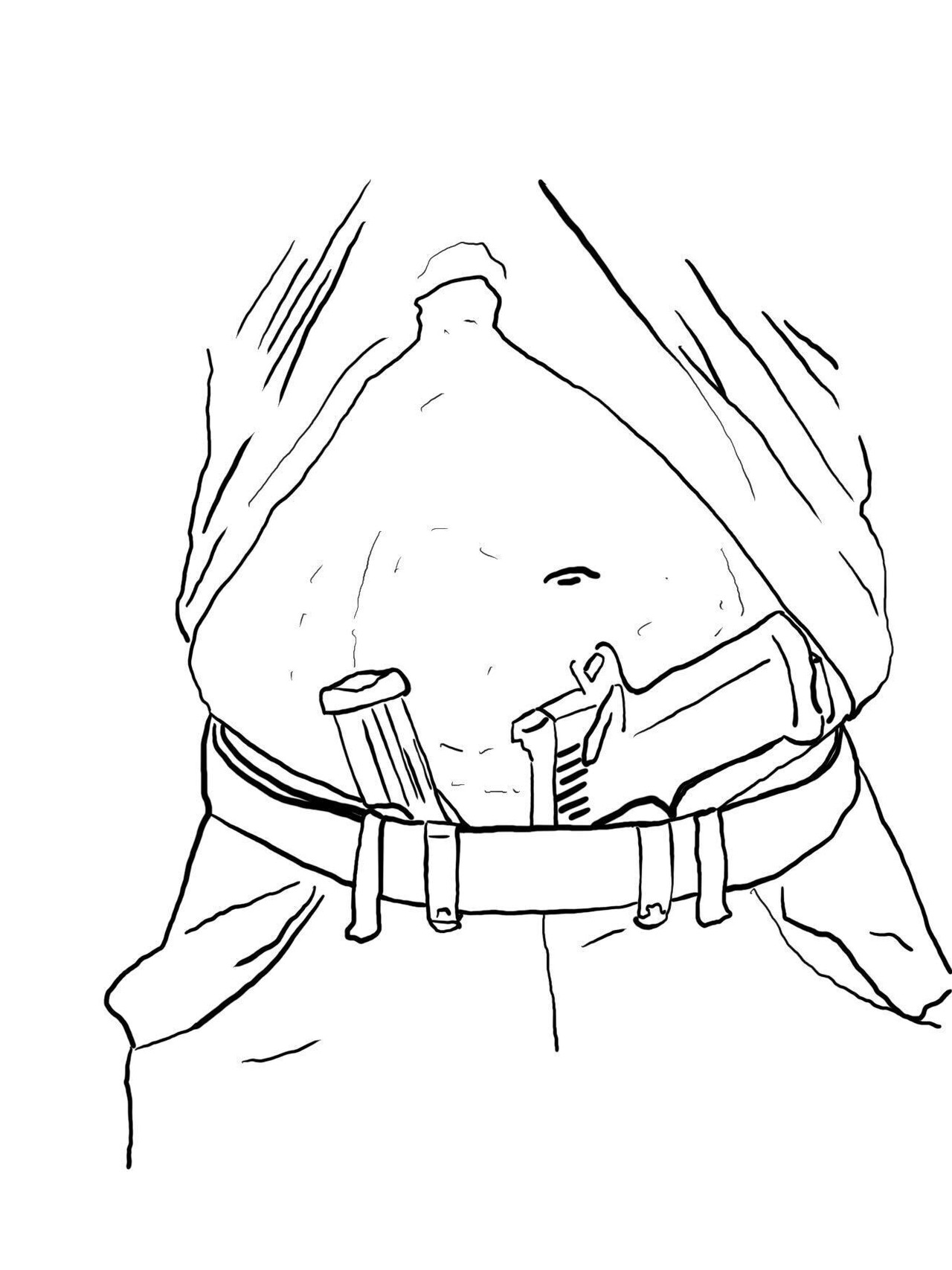
What we see very often, in cases where carriers are struggling with this, is that the limited range of placement forces the gun to interact with a peak on the torso, not a valley. This is the source of significant pistol grip printing. Eliminating that printing winds up requiring quite a bit more belt pressure than it would otherwise, which contributes to discomfort. Added to that, the attached magazine — even in cases where the attachment is flexible — acts like a concealment wing which opposes the concealment wing, and it applies a force which can pull the grip back out away from the body. This is a feedback loop for discomfort and poor concealment.
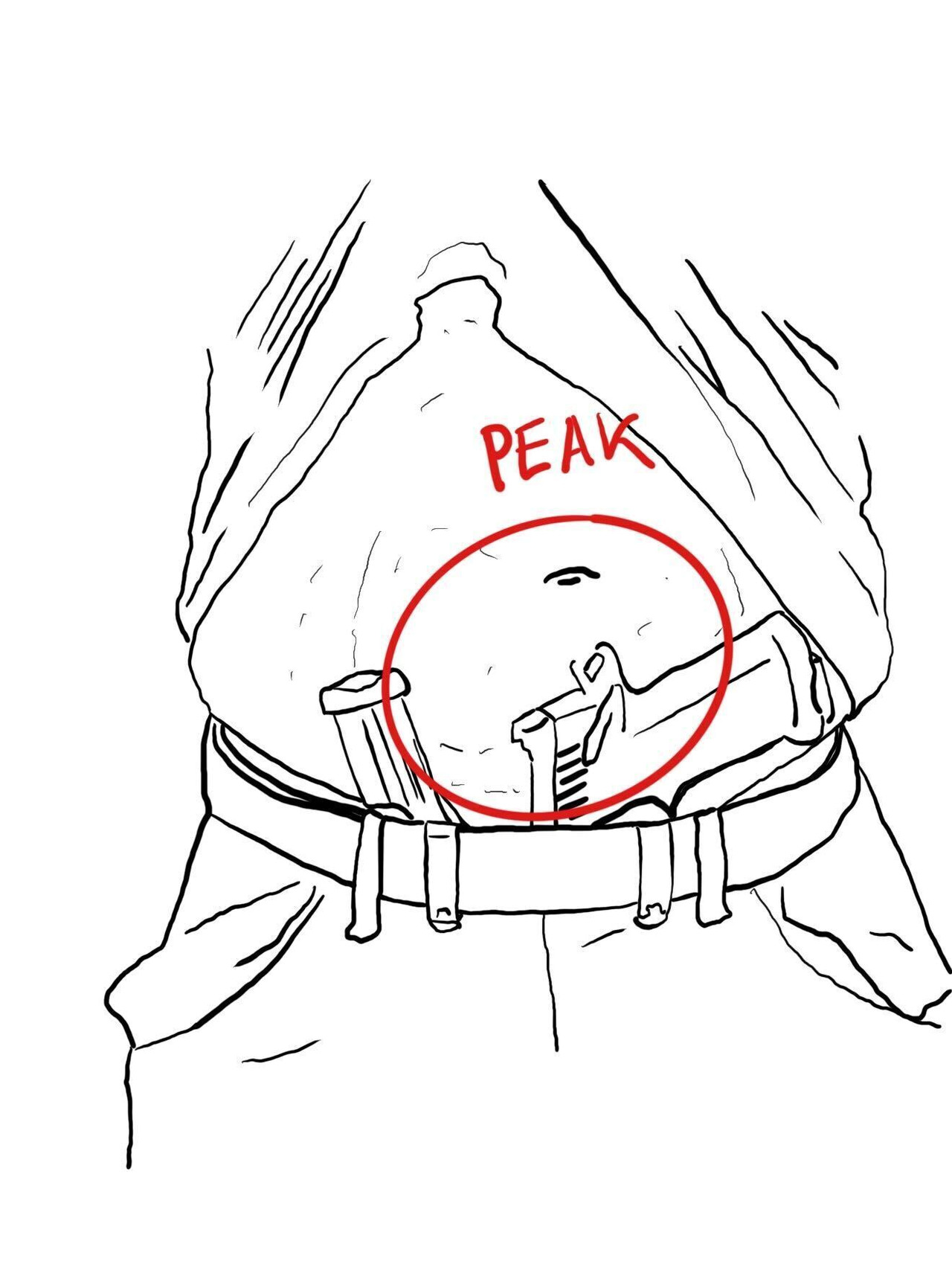 Sidecar position: gun is forced onto the centerline peak, causing print.
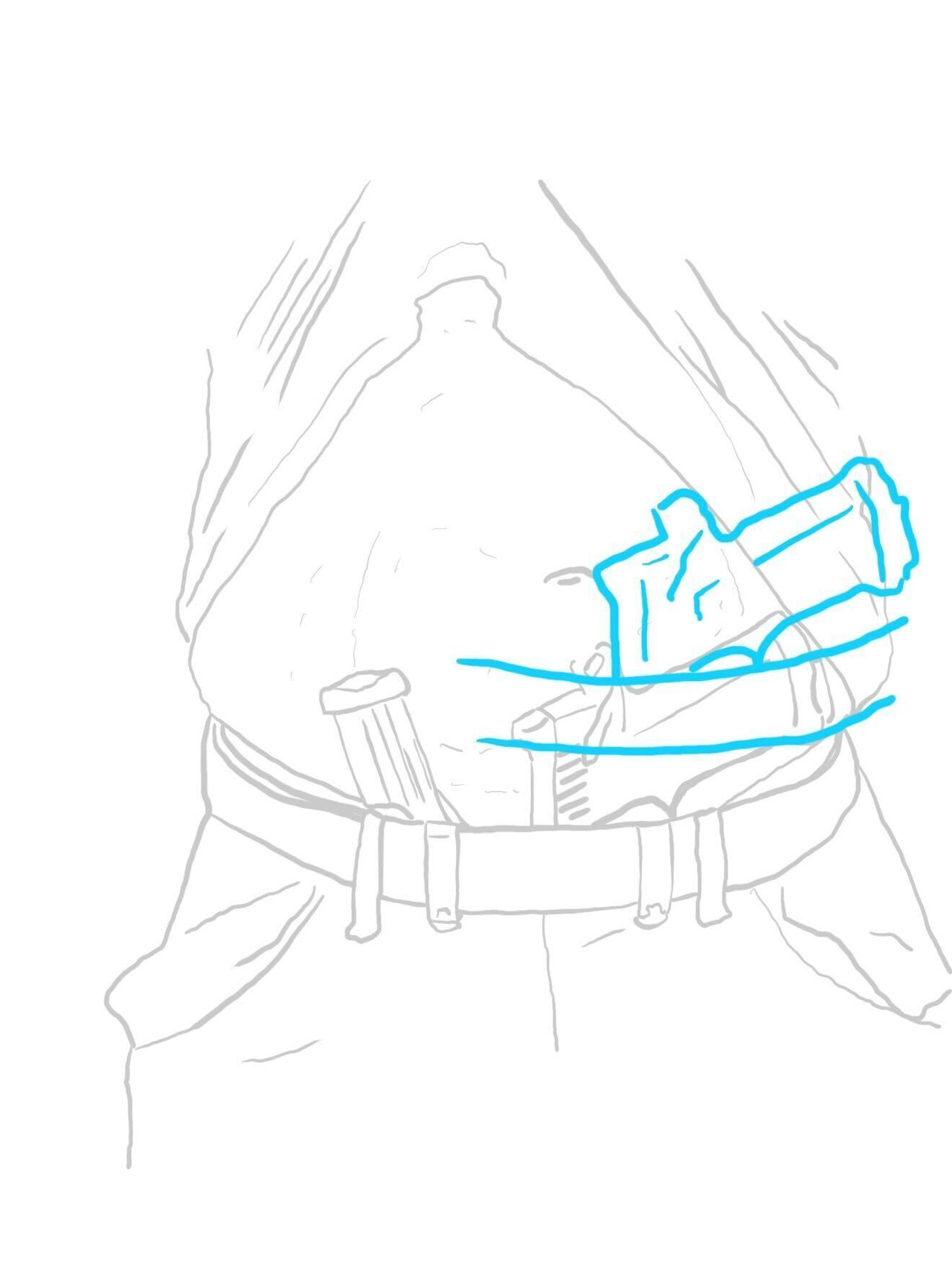 After detaching: gun moved out to the valley at 1:30, where it conceals cleanly.
Sidecar position: gun is forced onto the centerline peak, causing print.
After detaching: gun moved out to the valley at 1:30, where it conceals cleanly.
The fix: detach the magazine and find your sweet spots
No matter how flexible and adjustable the magazine attachment mechanism is, the number one most consistently helpful piece of advice we give to concealed carriers who are struggling with this issue is extremely simple: detach the magazine carrier from the holster and position each of those items independently in their ideal concealment sweet spots, further from the centerline of the body.
If the magazine and pistol are attached and riding at 11:30 and 12:30 and you're experiencing discomfort and printing, disconnect them and position them at 10:30 and 1:30. In more cases than I can count over the years, this has been the recipe for instant success.
The size 10 shoe analogy
Ultimately, the sidecar style is like a size 10 shoe. It's going to fit size 10 feet perfectly. The people whose bodies are a natural fit for this design are going to experience comfort and concealment success with no issue. But, if you've bought one and are struggling, it's almost certainly due to the body/design mismatch.
You didn't have any way to know in advance if you were a size 8.5 or a size 13 and that the size 10 holster just wasn't going to fit. But, using our Concealment Mechanics process, you can determine that in advance. By placing your holster and magazine in your waistband and following our process for finding your Concealment Sweet Spots for each item, you'll see exactly how far apart they are when you've accomplished the level of comfort and concealment you require.
If they're located at 10:30 and 1:30, you can predict that a sidecar style holster won't likely fit the way you want. If your gun and magazine wind up being really close to the centerline of your body, you're a likely candidate for that holster style.
Want to see this in action?
We made a full video walking through the diagrams and analysis above:
We're here to help — even if you bought from another brand
Like we say all the time, we're happy to help you succeed with concealed carry, regardless of the gear you're running, even if you purchased from another brand. If you are having any struggles we could help with, visit us in the PHLster Concealment Workshop on Facebook. Our team and our community will help you get dialed in, fast and easy.
About the author: Jon Hauptman, owner of PHLster. 15 years of holster making and design experience.