
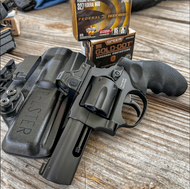
MAKING THE WHEEL MORE ROUNDED
Posted by Tamara Keel on Feb 10th 2026
In an earlier piece, we covered the available modifications for the Glock and other polymer-framed striker-fired modern pistols, so let’s take an opportunity to see what can be done to buff up the other end of the handgun modernity scale: the double-action revolver.
Over a century and a quarter after its introduction, the double-action revolver with a swing-out cylinder remains popular enough as a carry gat that here at PHLster we support it with the City Special holster, which can be used as a regular IWB/AIWB rig or combined with the Enigma system.
This column will primarily focus on small-frame snubbies, since they are the most popular for CCW, but we’ll also cover medium- and large-frame wheelguns.
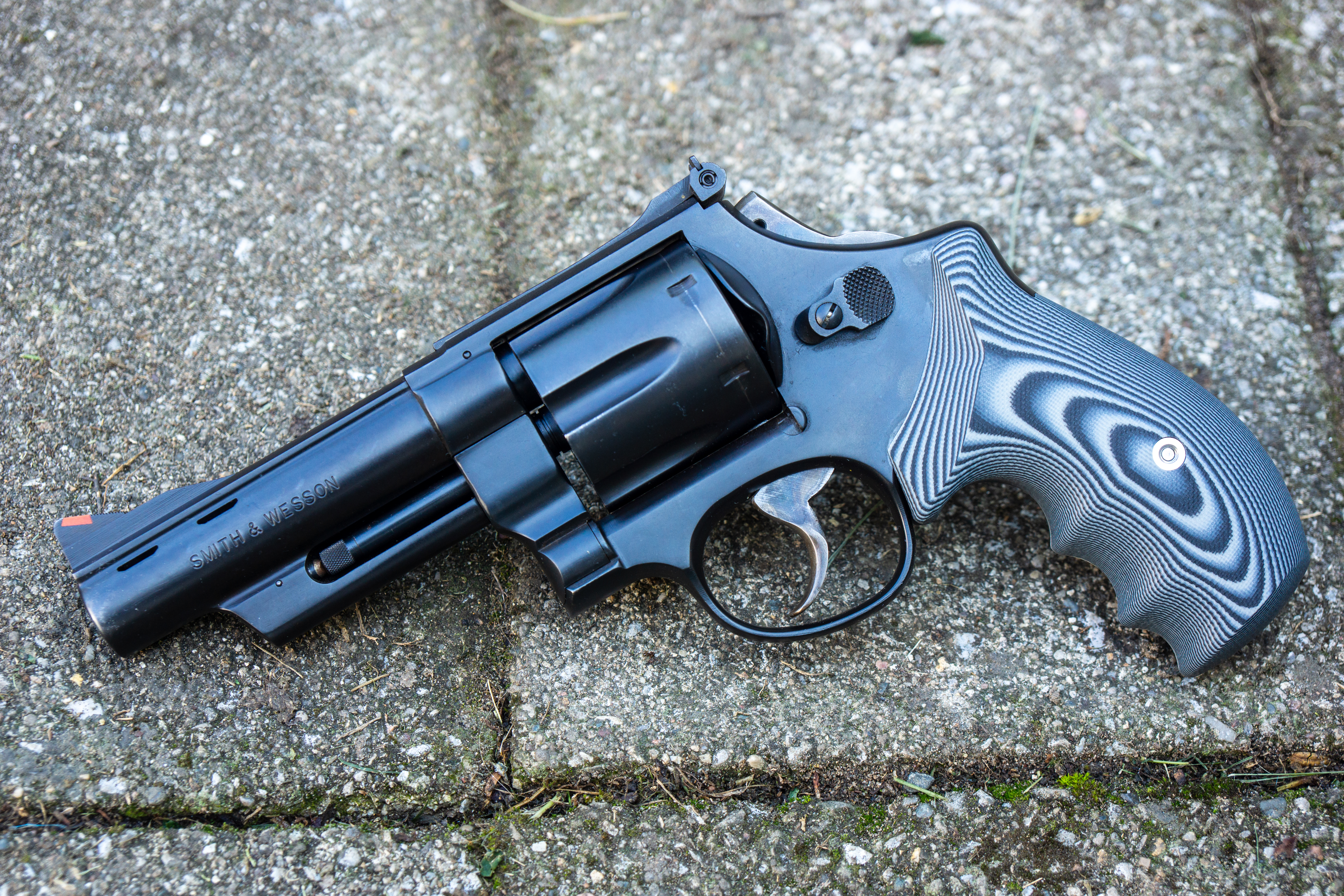
A large frame Smith & Wesson has its recoil tamed via quad Mag-Na-Porting and more comfortable G10 stocks from VZ.
Grip Upgrades for Revolvers
The biggest difference between revolvers and semiautomatic pistols is how easy it is to change the entire geometry of the interface between the user’s hand and the weapon by swapping out the grips (which, technically, are called “stocks” but this newsletter is largely a pedantry-free zone).
When the modern double-action revolver frame geometry was first laid out, back during the administration of Grover Cleveland, making their major combat debut in the guerrilla fighting in the Philippines, it was broadly assumed that these wheelguns would be fired one-handed and in single-action mode, using the strong-side thumb to cock the hammer. Double-action capability was considered an emergency measure in case the Juramentados or Spaniards breached the fort's walls and rapid fire was required.
The problems with this are twofold. The first is that when firing in fast double-action mode, the shooter’s hand rides too far up on the grip and allows the muzzle to point too low.
The second is that with lightweight small-frame revolvers, the backside of the trigger guard will deal a painful rap to the knuckle of the second finger on the shooter’s strong hand.
Incidentally, this gap behind the trigger guard is technically referred to as the “sinus” from the Latin for “pocket” or “curve”, which is why the pockets in the bones of your skull are called your sinuses.
If you look at modern grips for revolvers, they usually fill this area in to avoid your knuckle getting bloodied by the backside of the trigger guard, but if you are using a retro revolver like a new Heritage Rosco, a Smith & Wesson Model 36, or an old hand-me-down from your grandpa’s inheritance, you may want to upgrade the grips before using it for personal protection.
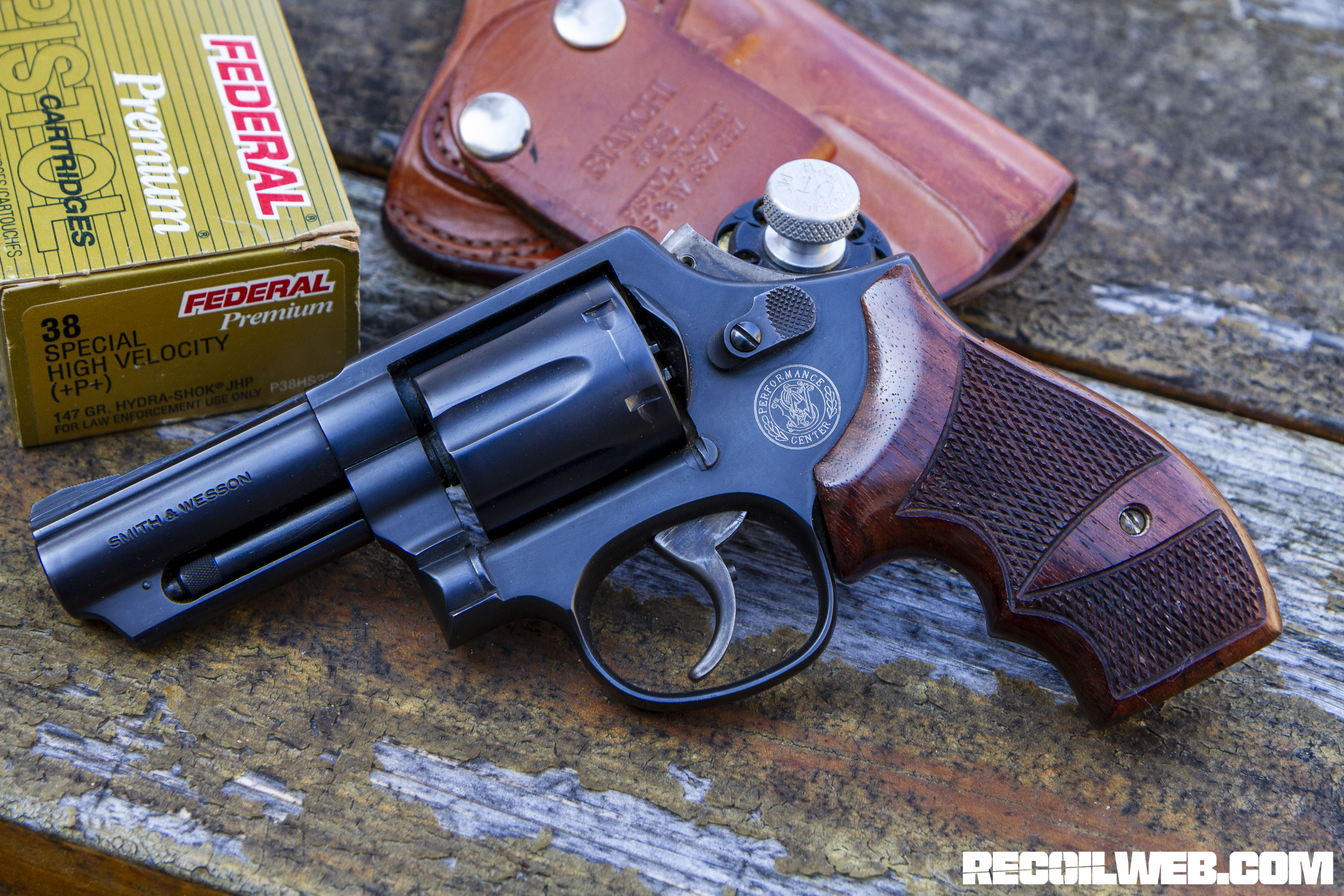
The Model PC13 from the early days of Smith & Wesson’s Performance Center sports an overtravel stop on the rear of the trigger and a beveled cylinder release to clear speedloaders.
Trigger Improvements
Some folks will have problems with the trigger on a small-frame carry revolver.
For a variety of reasons, it is hard to find one that comes out of the box with a trigger pull much lighter than ten to twelve pounds.
Worse, most of these modern small-frame snubbies use coil mainsprings. It’s a sad mechanical fact that coil springs are inherently subject to a phenomenon called “stacking”, in that the further you compress them, the harder it becomes to compress them further. The only way to ameliorate this is to use variable-rate springs, where the distance between coils differs over the length of the spring… but those are expensive, and we are talking about revolvers built to a price point.
If you have a trigger job done on your small-frame revolver, make sure it’s by a respected revolversmith who intends to leave the factory springs intact. The downsides of tampering with spring weights include unreliable ignition and a phenomenon where firing rapidly in double-action causes chambers to be skipped. That’s not a thing you want to happen, especially if you have only five beans in the wheel.
One thing that is not likely to have to be dealt with on a small-frame revolver is the texture or width of the trigger. Over the years, Smith & Wesson offered triggers in both wide and narrow widths, with smooth and serrated trigger faces.
A wide, serrated trigger face is great for slow-fire single-action target work, but miserable when trying to run the trigger fast in double action, using the crease of the first joint on the trigger finger. If you can’t find a replacement trigger, a competent gunsmith can grind that target trigger down to a narrower width and smooth and round off its face.
Sight Upgrades and Optics
Probably the most important topic to talk about on a carry revolver is what it has in the way of sights.
Traditionally, fixed sights on a small- or medium-frame revolver consist of a small front blade and a rear notch, essentially a trough machined into the topstrap of the frame. Trying to line this arrangement up in less-than-ideal lighting conditions, especially with a blued revolver and a dark-colored target, goes a long way to explaining why various “point-shooting” techniques were so widely promulgated in the early 20th Century.
The simplest solution is the old school one: brighten the front sight. Companies like Birchwood Casey offer a variety of fluorescent and even glow-in-the-dark paints for this, but for decades, the front sight was brightened with plain old nail polish in a bright color.
Some revolvers have a front sight blade that, instead of being machined integrally into the barrel, is attached via a tenon and a roll pin. If that’s the case, you can purchase an aftermarket front sight blade with a tritium insert and solve the problem.
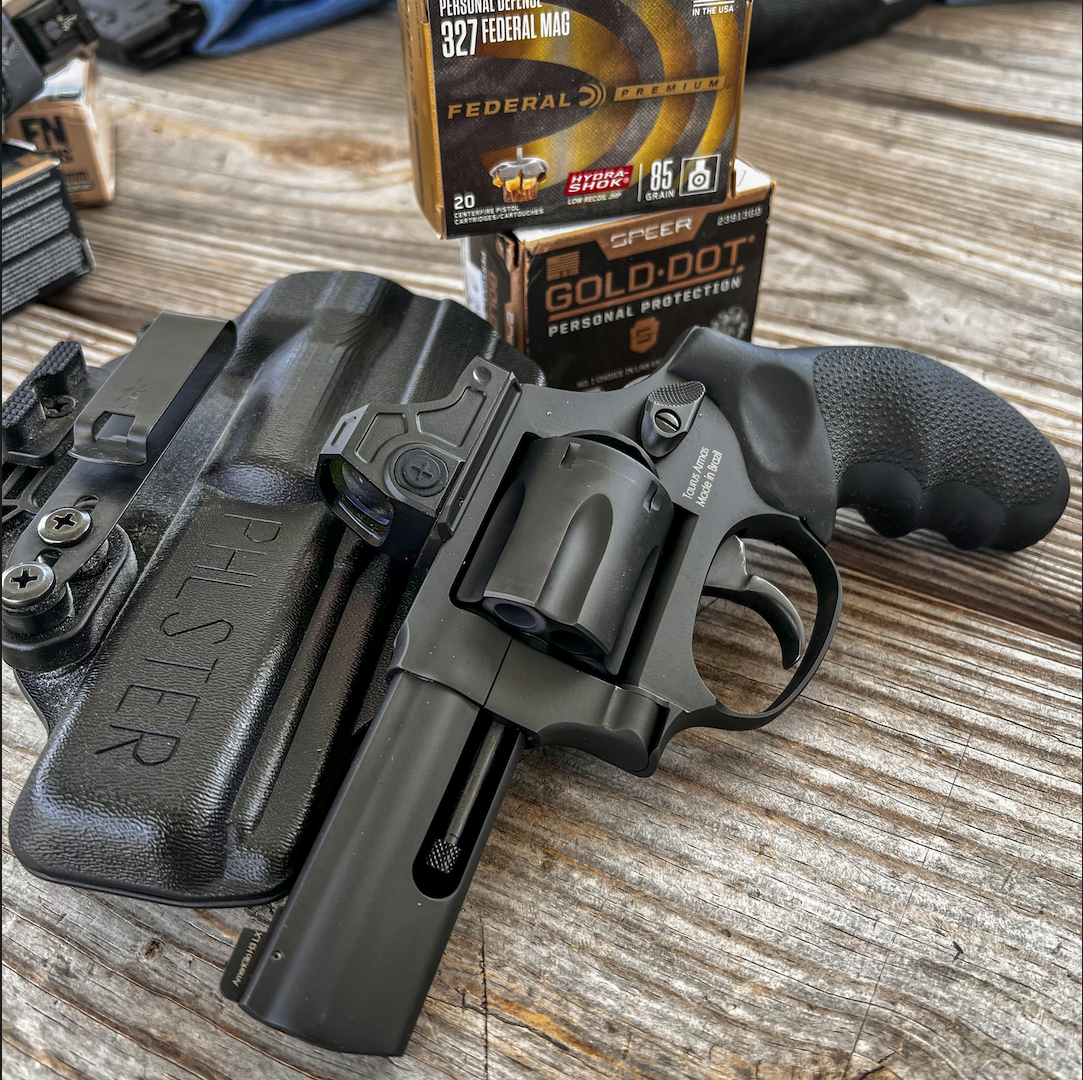
The optics-ready version of PHLster’s City Special is tailor-made for the TORO revolvers from Taurus.
One solution for attaching better sights to a small, concealable revolver is the T.O.R.O. System from Taurus, which gives the option of attaching an adapter plate compatible with the Holosun 507k and other optics that use the same footprint. There’s even been a version of our City Special designed to specifically accommodate this revolver with a mounted optic.
Some people joked that putting a miniature red dot sight on a revolver was like putting an aerodynamic spoiler on a horse-drawn wagon, but that’s not true. It’s more like using GPS while driving a horse-drawn wagon; you may not be going very fast, but you still need to know where to go.
Laser Grips
One sighting upgrade that I’m a big fan of on revolvers is the Lasergrip from Crimson Trace. Since they can be attached without compromising concealability or affecting holster selection, and since snubbie revolvers are often used reactively while being fired from unconventional positions, and the Lasergrip is activated simply by grasping the wheelgun in a firing grip, it’s a no-brainer of a modification. I’ve had a CTC Lasergrip on my personal S&W Model 432PD for over twenty years.
People debate over the best range to zero the laser on the revolver, but the thing is that the laser beam travels in a straight line, and so does the bullet, at least at handgun distances. I personally keep the laser dialed in so that it’s effectively parallel to the bore axis and use it as a coarse aiming indicator, knowing that out to twenty-plus yards the bullet hole will impact roughly an inch higher and an inch to the left of the red dot.
Revolver Modifications to Avoid
Are there any less-than-optimal modifications for revolvers?
Well, one popular one is chamfering the chamber throats to aid in reloading (this involves putting a slight bevel around the opening where you insert the cartridges). The danger here is that, unless this is done by a very skilled revolversmith, you could compromise ejection reliability and, frankly, reloading a revolver on the clock in a defensive gun usage is vanishingly unlikely.
Another is installing an overtravel stop on the trigger. While this is a fine modification if done right, if it’s done poorly, the stop can back out and result in the revolver not firing at all.
Lastly comes any kind of porting or compensation. This can definitely tame recoil and muzzle flip, but it’s important to be aware that it requires a certain amount of technique modification when firing from the pectoral index in a high retention position to avoid peppering your own face with ejects from the ports.
A revolver remains a viable carry option even in 2026, but modify it with an eye toward practicality, not Instagram coolness.