
Strong-Side Carry: A Practical Guide
Posted by Sarah Hauptman on May 27th 2026
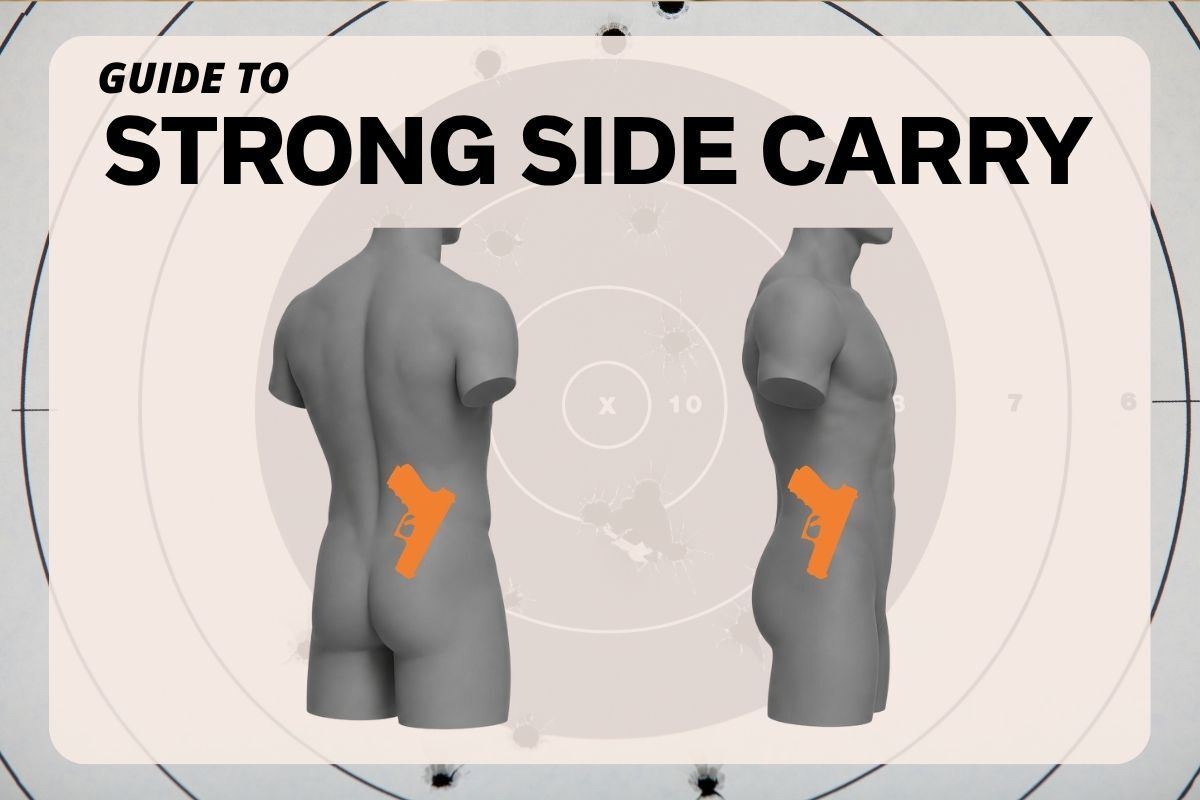
Concealment is generated when the pistol occupies the envelope of space between the clothing and the body. Where that envelope exists, and stays intact as you move, the pistol rides inside it, concealed. Where the envelope collapses, the clothing meets the gun directly and the gun prints.
Contents
Different carry positions create and maintain that envelope of space in different ways, and that's most of the difference between strong-side carry and appendix carry.
Appendix carry has the highest concealment ceiling of any position. At the front of the body, the way your anatomy is shaped and the way clothing drapes work together to maintain or increase that envelope. When you bend, squat, reach, and sit, the front of your garments will drape more. If you need maximum concealment in every context you carry, appendix is the position physically built to support it.
Strong-side carry generates concealment a different way. Behind the hip, your anatomy and your clothing don't hold that envelope open on their own to the same degree. Clothing there tends to tension across the gun rather than drape away from it. During all of the movements listed above, clothing will tension across the back, shrink-wrapping it across the gun. So instead of relying on the envelope being preserved for you, you generate concealment primarily with clothing layers and structure: an open-front cover garment and the cut and weight of what you wear over the gun. That works, but it depends on those layers in a way appendix carry does not. If peak concealment in all contexts isn't your highest priority, and you're comfortable generating concealment with clothing rather than relying on it to be preserved for you, strong-side carry is a comfortable option anywhere the concealment standard is more forgiving.
Appendix and strong-side answer two different questions: how much concealment do you need, and how do you want to generate it.
A note on terms. "Strong side" means your dominant-hand side. For a right-handed carrier, that's the right hip, roughly the 3:00 to 5:00 position on the clock. Strong-side carry can be done inside the waistband (IWB) or outside the waistband (OWB). This article covers both, because they share most of the same strengths and weaknesses, though they differ in a few important ways — especially in what they ask of your belt — and we'll flag those as we go.
When strong-side carry is the right choice
Strong-side carry tends to be the right call when one or more of these is true.
- You're newer to carrying and want a setup that works without a steep learning curve. Strong-side is forgiving. The gun sits outside the hinge point of your body, so it tends to be comfortable without much tuning, and you can reach acceptable concealment without a lot of craft. You'll still want to learn the concealment mechanics to get the most out of it, but strong-side lets you carry comfortably and responsibly while you build that skill, instead of making the skill a prerequisite.
- You already wear an open-front cover garment most days. A jacket, a vest, an unbuttoned flannel, a cardigan. Strong-side generates concealment with clothing layers and structure rather than with an envelope of space that anatomy preserves for you, and an open-front cover garment is that structure. For some carriers it's a cost — one more layer to add and plan around. If layered, open-front clothing is already how you dress, that cost is already paid, and the mechanism strong-side depends on is something your wardrobe already provides.
- Appendix carry is genuinely uncomfortable for you. Appendix places the gun inside the hinge point at the front of your body, against tissue that's often more sensitive, and it usually takes deliberate concealment craft and a tuned wedge to make that placement comfortable. No two people tolerate it the same, no matter how much craft you apply. If you've given appendix an honest effort and it still doesn't work for you, strong-side moves the gun outside that hinge point, onto a part of the body that generally needs fewer accommodations to carry comfortably all day. Strong-side has one comfort consideration of its own — pressure on the sciatic nerve behind the hip — which we cover later, but for many people it's the more tolerable option by a wide margin.
- You value all-day comfort over maximum concealment. This is a real and reasonable priority. If your day involves a lot of sitting, driving, or moving, and you want a setup you can put on and forget, strong-side's comfort can matter more than the higher concealment ceiling appendix reaches. It comes back to the question this article opened with: how much concealment do you actually need? If your honest answer is "not maximum," strong-side meets that standard comfortably.
When to think twice
Strong-side carry is harder to recommend in two situations.
- You can't or won't wear a cover garment. This is the limiting factor for strong-side carry. The setup generates concealment with clothing layers and structure, and the cover garment is a structural layer. Take it away and you've removed the mechanism. If a single shirt is all you'll wear, tucked or untucked, the gun will print when you move, and no amount of wedge tuning or holster adjustment fully closes that gap.
- You need maximum concealment in every context. If the gun has to stay genuinely invisible — under light clothing, across sitting and bending and reaching — that's the job appendix carry is physically built for: its envelope of space is preserved by anatomy and clothing across exactly those contexts. Strong-side, worn well, conceals reliably anywhere the standard is more forgiving, but "reliable where the standard is forgiving" and "invisible in every context" are different standards.
None of this makes strong-side a lesser choice. It makes it a specific one. Matched to your wardrobe, your body, and the concealment standard you actually need, strong-side carry does its job well, and the rest of this article is about doing it well.
The strengths of strong-side carry
Most of strong-side carry's appeal comes down to three things.
- It's easier to get right. You can reach acceptable concealment (provided a forgiving context) and comfort without much tuning or craft.
- It's often comfortable right away. Many carriers find strong-side tolerable from the first day, with little of the break-in period other positions can require.
- The gun rides outside your body's hinge point. Carried behind the hip rather than across the crease where your torso folds, the gun stays clear of your body's movement when you sit and bend. That clearance is a large part of why strong-side is immediately comfortable.
The drawbacks
Strong-side carry asks you to accept several real tradeoffs.
- Normal movement tends to increase printing. Sitting, bending, squatting, and reaching pull your clothing tight across the gun rather than letting it drape, so the gun is most likely to show exactly when you move.
- It has a low ceiling of maximum concealment. Worn well, strong-side conceals reliably for everyday purposes, but it cannot reach the deep, all-context concealment that appendix carry can.
- You usually can't watch the gun back into the holster. The holster sits behind your hip, out of your line of sight, so reholstering is often done by feel.
- It generally needs an open-front cover garment. A jacket, vest, or unbuttoned overshirt is doing real concealment work here, not just completing an outfit. Without one, strong-side struggles to hide the gun.
- Concealment often gets worse throughout the day without you noticing. Since it's outside of your field of view, it's hard to tell what's printing and who can see it. And if your pants tend to sag at all, sitting and squatting can create extreme concealment disruptions and printing when the gun is actively pulled away from your body above the belt. Wearing pants higher (and keeping them there) will help keep the gun in better contact with your lower back or kidney area. Otherwise, the gun becomes very obvious.
Strong-side carry vs. appendix carry, point by point
Concealment
The most significant difference is concealment. Appendix carry takes advantage of natural clothing drape, and normal movement helps it. When you sit, bend, or reach, your clothing tends to fall further away from your body, which grows the envelope of space and conceals the gun better. Strong-side carry behaves the opposite way. Behind the hip, those same movements pull your clothing tight, so the fabric tensions across the gun and printing increases exactly when you sit, squat, or bend. With appendix, movement works for you. With strong-side, it works against you.
Reholstering
With appendix carry, you can see the open mouth of the holster as you reholster, which lets you watch the gun back into a clear holster. With strong-side carry, the holster sits behind your hip where you can't see it, so you will often be reholstering by feel. That isn't disqualifying, but it does raise the importance of doing it right: reholster slowly, deliberately, and with your full attention, and never rush a holstering stroke you can't see.
I have seen so many people point their gun at themselves when they're reholstering strong-side, risking a through-and-through wound which would transect the entire pelvis.
It's out of sight, out of mind to them, but they'll still insist that it's "safer" than appendix carry.
Access and retention
Appendix carry keeps the gun at the front of your body, where it is easier to access and defend from compromised positions, such as on the ground or in a grapple. Strong-side carry places the gun behind your hip. That position can be reached by someone behind you, and defending it is harder. The arm articulation it takes to protect a gun behind your hip puts you in a weaker structural position and exposes you to underhooks, and the gun you are trying to protect is behind you, where you have the least leverage and awareness. This is a defensive consideration rather than a concealment one, but it is a real part of the tradeoff.
Comfort
Appendix carry is often less comfortable at first and takes some adjustment. Because the gun usually sits inside the hinge point of the body, against more sensitive tissue, it takes deliberate concealment craft to make appendix both comfortable and unobtrusive. Strong-side carry is generally more tolerable. With the gun outside the hinge point, fewer accommodations are needed to make all-day carry physically comfortable, and the area of body contact is usually less sensitive. Strong-side does have one comfort issue of its own to watch: a gun carried directly behind the hip can press on the sciatic nerve and cause discomfort or numbness down the leg. If you feel that, adjusting where the gun sits will usually relieve it.
Do the concealment mechanics still apply?
Yes — all of them, and this matters more than it might seem. It's easy to assume Concealment Mechanics are just for AIWB. They aren't. Sweet Spot, Grip Tuck, and Grip Rotation all carry over to the strong side.
This follows directly from how strong-side generates concealment. The concealment mechanics are the techniques you use to manage the envelope of space: where the gun sits in it, how the gun is angled, how your clothing rides over it. Appendix carry has much of that envelope preserved for it by anatomy and clothing. Strong-side carry doesn't, which means on the strong side you are generating concealment actively, with your cover garment and with these mechanics. It's the same work either way. There's simply more of it left for you to do behind the hip, and that makes the mechanics more necessary, not less.
If you want a refresher on what each mechanic is and how to apply it, our Basics of Concealment Mechanics resource covers them in full, and everything in it holds true for strong-side carry.
The Sweet Spot mechanic is about keeping the gun off your body's "peak" — the point that already protrudes most and tents your clothing the hardest. With appendix carry, that peak sits around the 12:00 centerline. With strong-side carry, the nearest peak is the point of your hip, around 3:00. Carrying the gun on that hip peak stacks the thickness of the gun on top of a spot that already sticks out, and printing gets worse. So your strong-side sweet spot is behind the hip, generally 4:00 to 5:00 — not on the 3:00 hip itself. Positioning the pistol behind that peak, instead of on it, is a small change that noticeably improves strong-side concealment. You still want to identify the area where you have the most amount of clothing drape and where your gun can start this process in the flattest position against the body.
Wings and wedges still work, too. When you carry IWB on the strong side, a wedge does the same job it does at appendix: it fills the gap between the bottom of the holster and your body and levers the grip in toward you, where it prints less. Belt pressure is available the same way. A wing, a claw, or a similar holster feature uses belt pressure to rotate the grip inward. You'll likely need less wing and wedge compared to AIWB because the returns will diminish quickly and, past a certain point, they just push your belt outward instead of pushing the gun inward. Keep in mind, depending on holster design, what's doing the work of a wing might not look like the wings you're used to seeing on an AIWB holster. A smartly designed OWB pancake holster will use asymmetry to accomplish the same effect. A technique we use on our Summit OWB holster involves offsetting the holster belt loops so that tightening the belt pulls the grip-side further inward than the slide-side. The popular and legendary Raven Concealment Phantom holster had this kind of function molded directly into the shape of the holster.
However, expect a smaller return on these inputs than you would get at appendix. The tissue behind your hip is less pliable than the soft tissue at the front of the body, and there's more pelvic structure to contend with. Firm tissue and bone resist concealment inputs. They don't "give" the way the abdomen does, so the same wedge or the same belt-driven rotation produces less movement and less concealment gain. The mechanics genuinely improve strong-side carry, and you should use all of them. Just don't expect them to deliver appendix-level results, because the body behind the hip won't cooperate to the same degree. This is the ceiling difference from the start of the article, showing up in the details.
OWB considerations
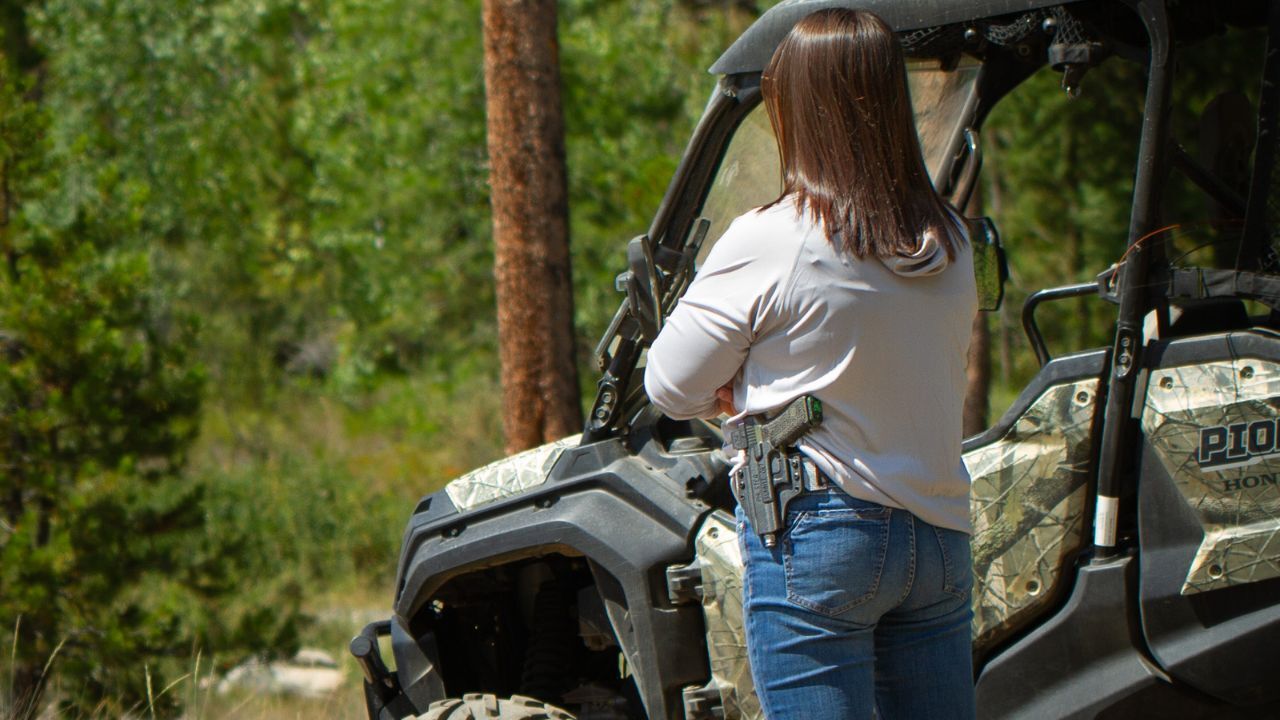
An OWB holster hangs the gun off your belt rather than holding it inside your waistband. With IWB carry, the belt's job is mostly to restrain the holster and sandwich it against your body. With OWB carry, the belt also has to support the full weight of the gun hanging from it. That is a different demand, and it is why a proper, sturdy gun belt is not optional for OWB strong-side carry. A soft or flexible belt will sag under the load, and the holster will tip and shift instead of staying put.
Be aware that a stiff belt carrying weight on one side has a tradeoff of its own. The mass of the gun pulls down on your strong-side hip, and a rigid belt transmits that pull around your waist, so the belt can dig in on the opposite side, creating discomfort and imbalance issues. It is manageable, and the right belt and holster minimize it, but it is worth knowing going in. Additionally, if you're a smaller person, you are likely to experience this to a greater degree. A stiff belt will have a tendency to create gaps where it doesn't conform to your body and concentrate the pressure on the remaining areas where it contacts you the most.
Tips
- Get behind the peak. Position the gun behind the point of your hip, generally between 4:00 and 5:00 — not on the 3:00 hip itself. (And never 6:00. Always avoid positioning the gun across your spine.)
- Plan your cover garment. Strong-side carry gets most of its concealment from clothing layers and structure. Decide what your open-front layer is before you head out, and treat it as part of the setup rather than an afterthought.
- Use Concealment Mechanics. Sweet Spot, Grip Tuck, and Grip Rotation all work behind the hip, and all of them help. Our Basics of Concealment Mechanics resource covers how to apply each one.
- Tune the hardware. For IWB carry, add a wedge and use a wing or claw to draw the grip in with belt pressure. Expect a real improvement — just not appendix-level results.
- Use a true gun belt for OWB. An OWB holster needs a belt stiff enough to carry the gun's weight without sagging.
- Reholster slowly and deliberately. You usually can't see the holster behind your hip — don't rush. Step your legs out of the path of the muzzle, ensure that your clothing or cover garment isn't interfering with the holster, and give this your full attention.
- Adjust if you feel sciatic nerve discomfort. Pressure or numbness behind the hip or down the leg usually means the gun is sitting on the nerve. Shift its position slightly until the pressure is gone.
Strong-side carry works well for a great many people, as long as you're making an informed choice, crafting concealment deliberately with clothing and Concealment Mechanics, and accepting its limits instead of fighting it. Like every part of concealed carry, it is a process you can learn.
Need a second set of eyes?
If you'd like help dialing in your strong-side setup — choice of holster, position on the body, cover-garment strategy, wedge tuning — come visit us in the PHLster Concealment Workshop on Facebook. Our team and our community will help you get sorted regardless of which brand's gear you're running.
About the author: Sarah Hauptman, owner of PHLster Holsters.