
MODIFYING A CLASSIC: THE 1911
Posted by Tamara Keel on Jul 14th 2026
Since the late 1990s it’s been possible to buy a turn-key 1911-pattern pistol that’s well set up for concealed carry. It’s also been possible to buy one that’s fairly ineptly set up. This article is going to help separate the custom wheat from the cheesy trash in the world of modifications to John Moses Browning’s original design.
Prior to the advent of Kimber entering the 1911 biz, it was common practice to purchase a Colt’s Government Model or one of its clones from companies such as Springfield Armory or Auto Ordnance and take it to a gunsmith for a suite of modifications.
The Essentials: Sights
First among these was a good set of sights. At the time, all factory 1911s had a standard rear dovetail and a front sight attached via a tenon that was staked to the slide. This tenon, a metal peg 0.058” in width, was dimensioned to hold a minuscule sliver of a front sight and using it to attach a larger one, especially one big enough to hold a tritium vial, would cause the tenon to shear under recoil forces, spitting the front sight right off the gun.
Colt switched to a wider 0.125” tenon to cure this problem on everything but its reproduction models. Almost every 1911 using staked front sights over the last thirty years uses this size except those that use a 0.080” tenon developed by Springfield Armory. If you’re upgrading the sights on your 1911 that has a staked front sight make sure you select the correct Narrow, Springfield (“Medium”), or Wide replacement sights.
Fortunately most modern carry-oriented 1911s have gone to dovetails for both front and rear.
The rear dovetail will either be the standard retro type or else cut to allow modern snag-free sights that give a longer sight radius and won’t tear up the shooter’s hand when running the slide from over the top. These are almost always Novak-style dovetails except Kimber, who use Heinie-style dovetail cuts. Again, if unsure consult a gunsmith before buying upgraded sights.
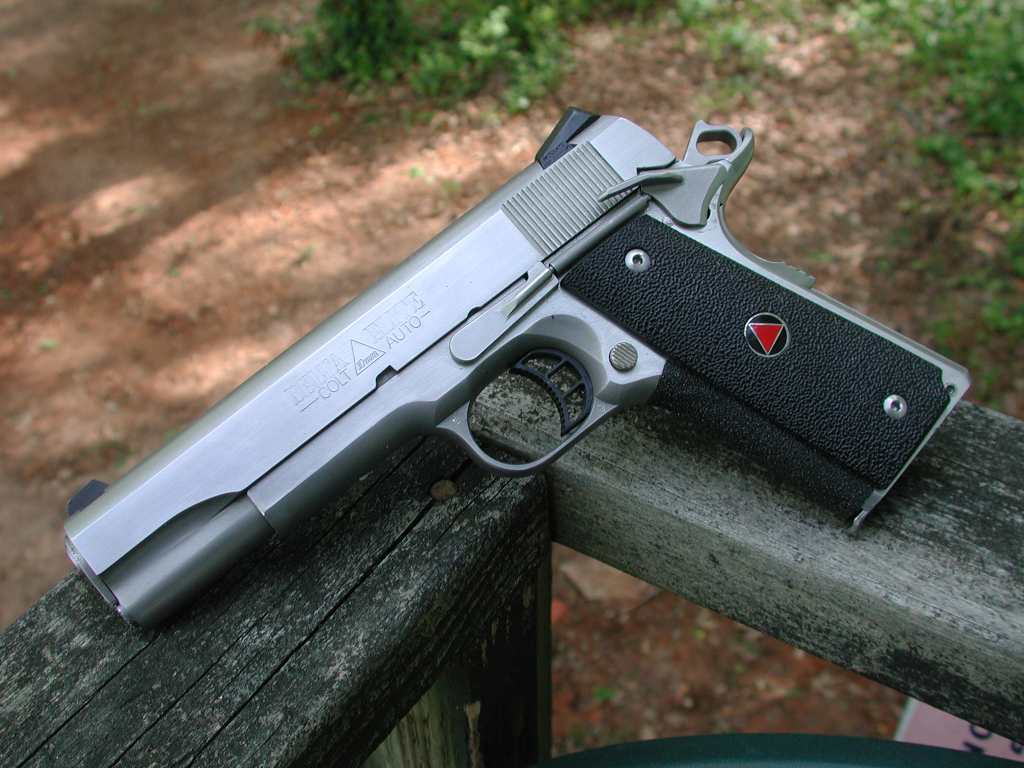
This Colt Delta Elite has had Novak Lo-Mount sights added, among other mods. The skateboard tape on the frontstrap is a classic method of adding some grip quickly and easily.
Safeties
One upgrade that comes on modern 1911s and should be added to an older one intended for carry is a beavertail or “ducktail” styled grip safety. This allows for choking up your grip on the pistol for maximum recoil control without risking hammer bite giving you stigmata on the webbing of your thumb or the bottom of the reciprocating slide. It also assists in properly and consistently indexing your grip during the presentation.
A quality beavertail grip safety will have some sort of bump, hump, ridge, or swelling at the bottom. This isn’t an affectation, but rather ensures that the grip safety will be properly disengaged even with a good, high grip.
Once upon a time, when people rode motorcycles without helmets while chain smoking and snorting fat lines of powdered asbestos, 1911 guys would pin the grip safety to avoid the need for that, but we’ve learned a bit about safety since then. Don’t disable mechanical safeties on your sidearm unless you really want to maybe have it come back to haunt you.
A slightly extended thumb safety is also a plus. It’s easier to reliably operate and also it gives your strong-side thumb someplace to park itself while firing to ensure that proper high grip. Again, fortunately most every modern carry-oriented 1911 pattern pistol comes with these from the factory these days.
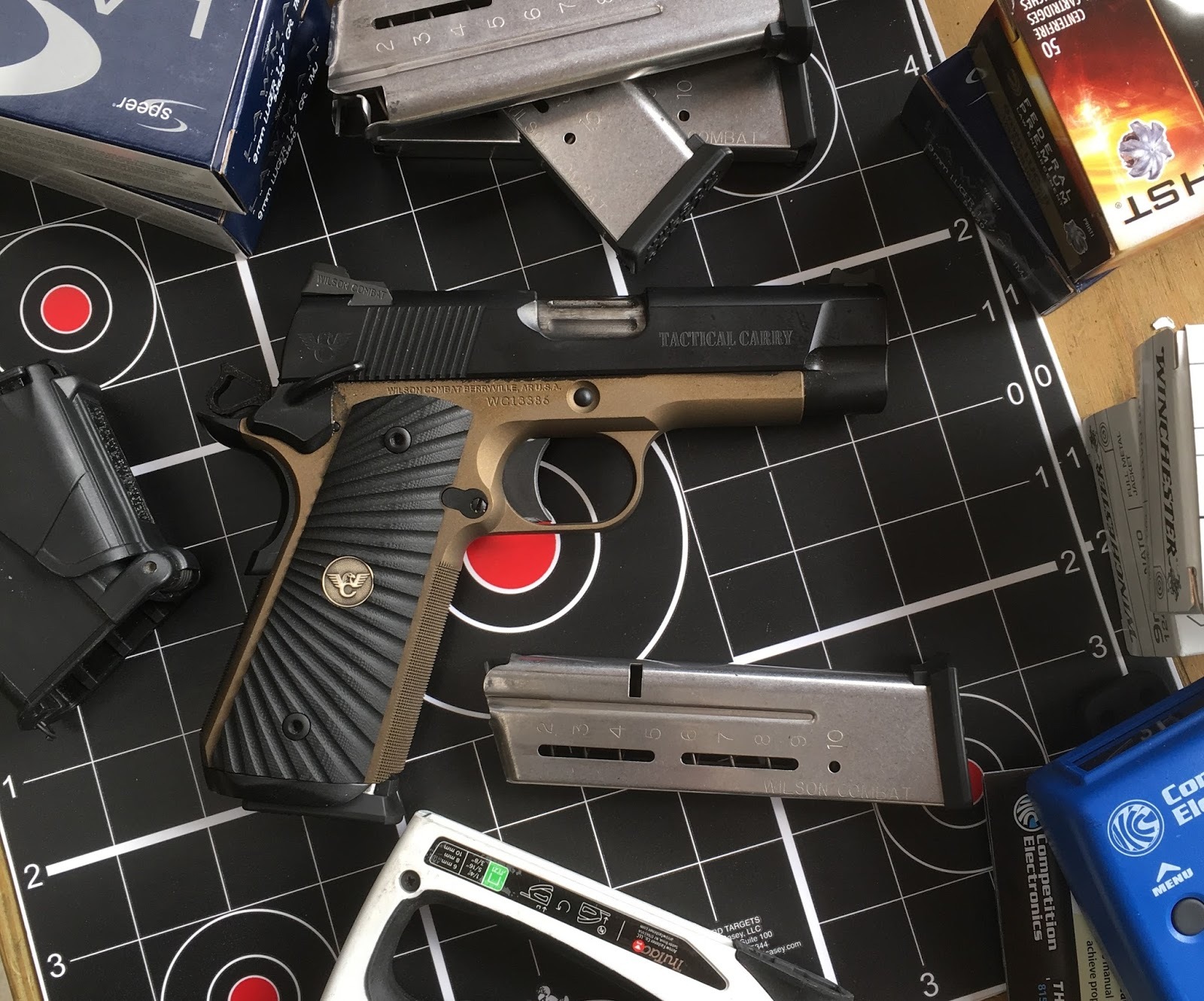
The end of the slide stop axle on the Wilson Tactical Carry Professional model is countersunk to prevent the trigger finger from inadvertently pushing it out when held in a high index position.
Do be aware that the most common type of ambidextrous safety for 1911s uses a two-piece axle that’s a potential mechanical failure point and the weak side part of the safety is retained by the grip panel. Also, it can get wiped off in the holster by brushing against furniture or whatever unless the holster is specifically constructed to pin the safety in place. The world was just less southpaw-friendly in the first decades of the last century.
The Trigger
We’ve covered sights and safeties, and the last really necessary feature that makes a 1911 ideal for carry is a good, manageable trigger.
The original government issue M1911 pistols had a trigger that was machined from steel; the trigger bow inside the pistol and the shoe itself inside the trigger guard that was the bit that interfaced with your finger, all that was a single piece of steel. That meant that trigger pull could only be made so light before the inertia of the heavy trigger itself would trip the sear under recoil.
Competition forced the innovation of lighter trigger assemblies, and this is the source of the commonly seen aluminum trigger shoes with lightening holes drilled in them. By the turn of the Millennium, it was not uncommon to see STI polycarbonate trigger shoes mounted to titanium bows.
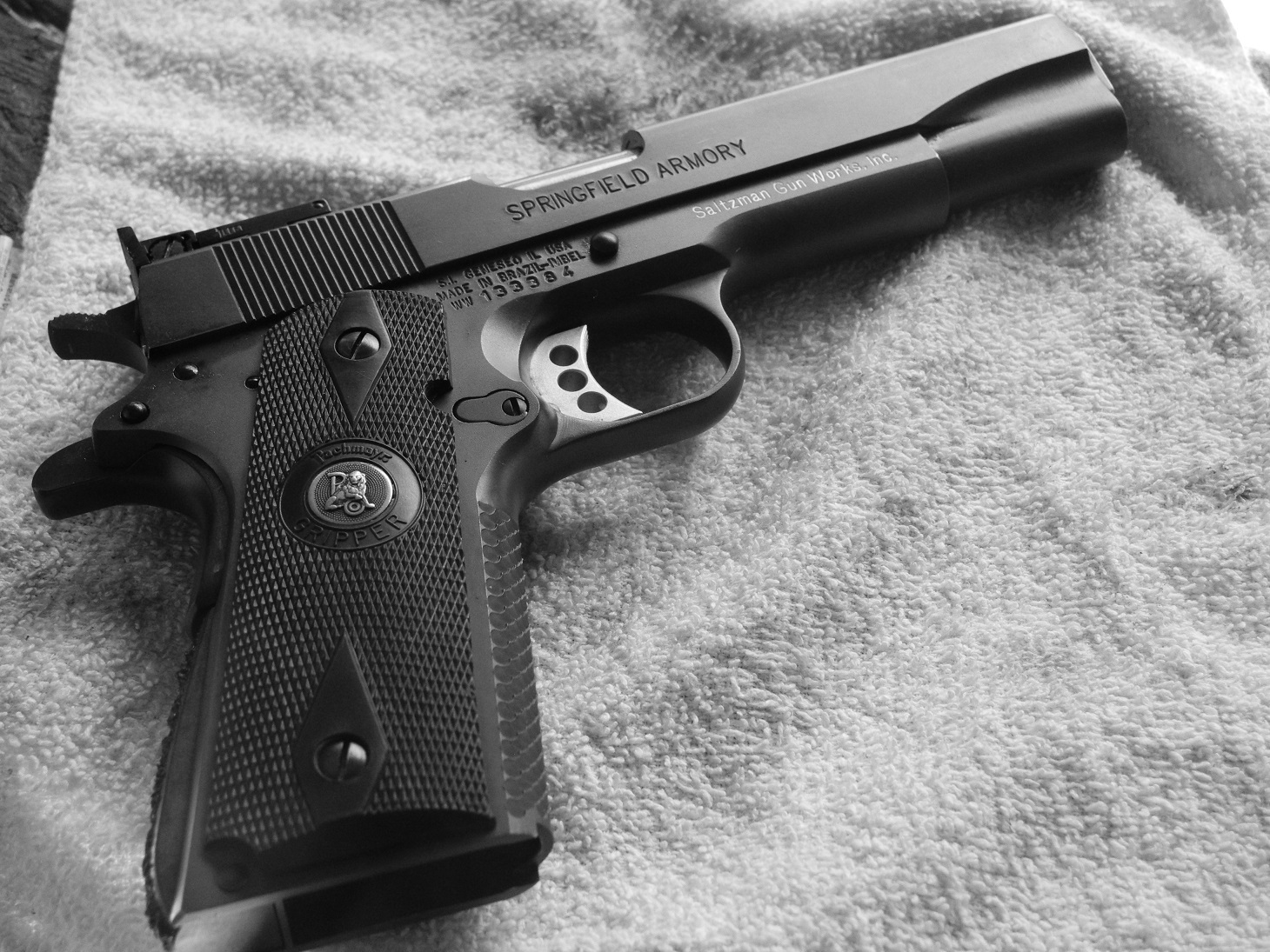
A Springfield Armory 1911 clone modified for the Hardball class in Bullseye shooting with a Bo-Mar adjustable rear sight, scalloped texturing milled into the frontstrap, and Pachmayr rubber grip panels.
With a trigger shoe that light, combined with the direct actuation of the sear inherent in the 1911’s lockwork, you can get a freakishly light target trigger on a 1911 pattern pistol… that is totally inappropriate for carry use.
If you examine the Request For Proposal (RFP) that led to one of the last and most famous 1911 duty contracts, the one that resulted in the purchase of the Springfield Armory Professional Model for use by FBI SWAT teams, it specified a trigger pull weight no lighter than 4.5 pounds. Can you get a 1911 trigger lighter than that? Oh, sure. Should you, on a carry gun? Oh, hell nah.
The Maybe List
If that covers the necessary features, are there ones that might be desirable if they fit your personal needs? Sure. Let’s hit a couple of those here.
The first would be forward cocking serrations. While I’m personally a huge fan of grabbing a pistol’s slide up by the loud end to cycle it, I realize that some people have basically done it that way forever. As long as you don’t let any meaty bits get out in front of the muzzle, it doesn’t technically violate any rules I guess. These actually originated about the time that people first started affixing big optics on open class IPSC guns back in the day and discovered that, once you had a big dot on a frame-mounted non-reciprocating optic you could no longer access the rear slide serrations to function the gun.
About the only downside to them is they chew up the insides of leather holsters (my gunsmiths at Coal Creek Armory referred to them as “the lesser manglers”) but if that were a worry of yours, you wouldn’t be reading PHLster’s site.
There’s also a light rail, which those gunsmiths called “the greater mangler”, again for its effect on the interior of leather holsters. While the utility of a weapon-mounted light on a CCW gun outside the house is debatable, one clear advantage it offers is that if you stick an X300 on it, you can use our Floodlight holsters with your 1911-pattern pistol without worrying about whether your specific model is supported.
Another mod on the “Maybe List” is a magazine well. You can get fairly low-profile ones for a single stack 1911, such as the one from Smith & Alexander. It doesn’t add a ton of bulk to the pistol and certainly aids reloads. In fact the aforementioned FBI gun requested them, knowing they’d be carried by plainclothes SWAT-qualified agents.
On the other hand, reloads on a CCW gun are as rare as having the winning Powerball ticket knocked out of your hand by the meteorite that just hit you. Simply beveling the magazine opening will get you most of the benefit without any added bulk or parts. It’s up to you.
The One to Skip
Is there a popular mod that I think is counterproductive and best avoided? Why, yes there is.
The full length guide rod, often abbreviated “FLGR” (which is pronounced in my head as “vulgar”) has no real positive effect on the cycling of the pistol. Oh, sure, it can make a rattly gun feel smoother when you hand-cycle it, which is why I save the ones I take out of carry guns to drop into basket case projects that I’m trading in, but it doesn’t actually do anything.
People say it keeps the recoil spring from kinking, but even a cursory glance at a cutaway of a 1911 will illustrate that there is nowhere for the recoil spring to kink to. All they do is complicate disassembly and reassembly, possibly causing it to require tools to do so, when one of the neater features of the Government Model is that the pistol can be detail stripped using only its own parts as tools.
The old joke goes that a full length guide rod aids in extraction and feeding: The extraction of money from the wallet of the person buying it and feeding that money into the bank account of the person selling it.
About the Author
Tamara Keel has spent more than 15 years as a dedicated student of the defensive handgun, logging over 750 hours of formal training since 2008 under many of the most respected instructors in the field, including Massad Ayoob, Craig Douglas, Tom Givens, Pat Rogers, and Louis Awerbuck. Her coursework spans foundational marksmanship through force-on-force and entangled-fight training like Shivworks ECQC, along with appendix-carry-specific instruction from Spencer Keepers and Scott Jedlinski. Her writing on firearms and concealed carry has appeared in Recoil, Shooting Illustrated, American Rifleman, and USCCA’s Concealed Carry Magazine, among others. She writes for PHLster’s education library, bringing a daily-carry perspective grounded in training rather than theory.