
Glock 17 Gen6 Review: What Changed, and Does It Fit Your Holster?
Posted by PE Fitch on Nov 12th 2026
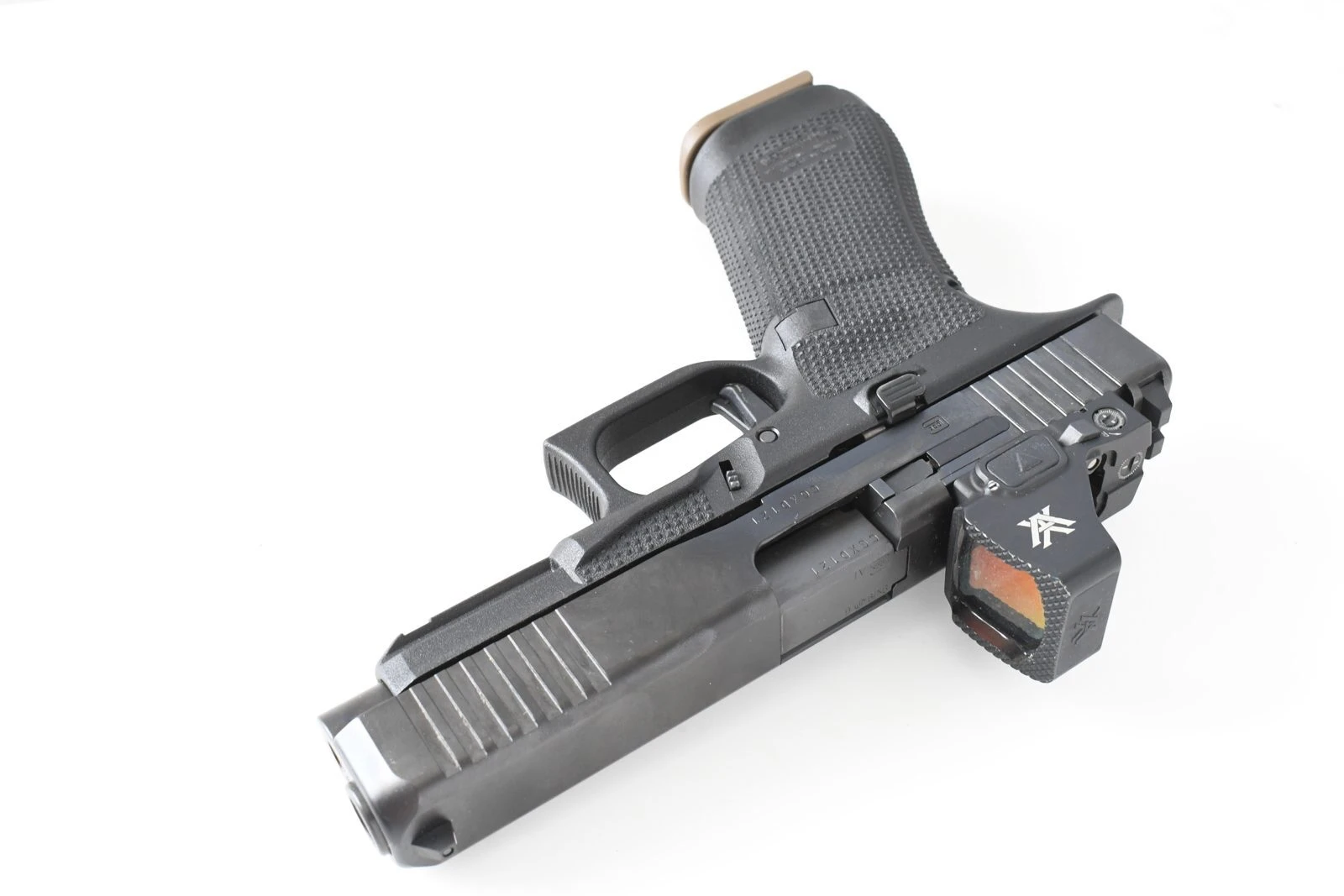
Unless you’ve been sleeping under a rock, Glock’s unveiling of the sixth generation of its signature handgun has been some of the biggest news in the firearms industry for 2026.
Last December, I traveled to Smyrna, Georgia to cover the product launch along with several other firearms journalists and YouTubers. This event was a major deal for Glock, too. The Austrian pistol giant had never undertaken a major product launch to this extent. In addition to the press junket I was part of, Kathrin Glock and other prominent members of Glock leadership including both the Austrian and US Glock CEOs were also there. They took the time to meet and mingle with us (the press) while we spent the day learning about the new Gen6 models.
My trip to the event culminated in an article I titled A Brief Review of Glock’s New Gen6 Models published by NRA Media that same month.
Gen6’s New Gist
The gist of the new Gen6 is simple: it’s the iteration over the previous Gen5 design, which was probably the most significant update to Glock pistols since they were first created. The fifth-generation not only standardized ambi-controls on full-size double-stack models, but it also ushered in the Glock Marksman Barrel and a tighter lockup compared to previous generations. I mention this because Gen5 accuracy and consistency has been incredible over different makes, models and calibers.
Ergo, the Gen6 is the logical continuation of the Gen5.
Gen6 keeps that Gen5 ambidexterity along with the accurate Glock Marksman Barrel.
It also retains the true essence of Glock’s “Safe-Action” tilting delayed-blowback design. That is to say, when you’re shooting a Gen6 Glock, there is no mistake that you’re shooting a Glock through and through.
The most important revision to Glock’s new generation is probably the complete re-contouring of the grip and frame. Gen6 models do retain the same 22-degree grip angle, but quite frankly, the grip angle was never the issue. This also means that any and all Glock magazines still work.
Gen6 Holster Fit
As I write this in the latter half of 2026, it’s evident that holster fit compatibility is a hot topic that many consumers are interested in. It tracks, since Glock pistols dovetail neatly into a massive ecosystem of cross-compatible parts, gear and accessories. Naturally, end-users are concerned about cross-generational compatibility with the new pistols.
As far as PHLster holsters are concerned, I’ve got a mix of new and old units that I’ve tried out with my personal Gen6 Glock 17 (and a Gen6 Glock 45 COA on loan). Other than holster fitment, the rest of the review focuses on the Glock 17 solely.
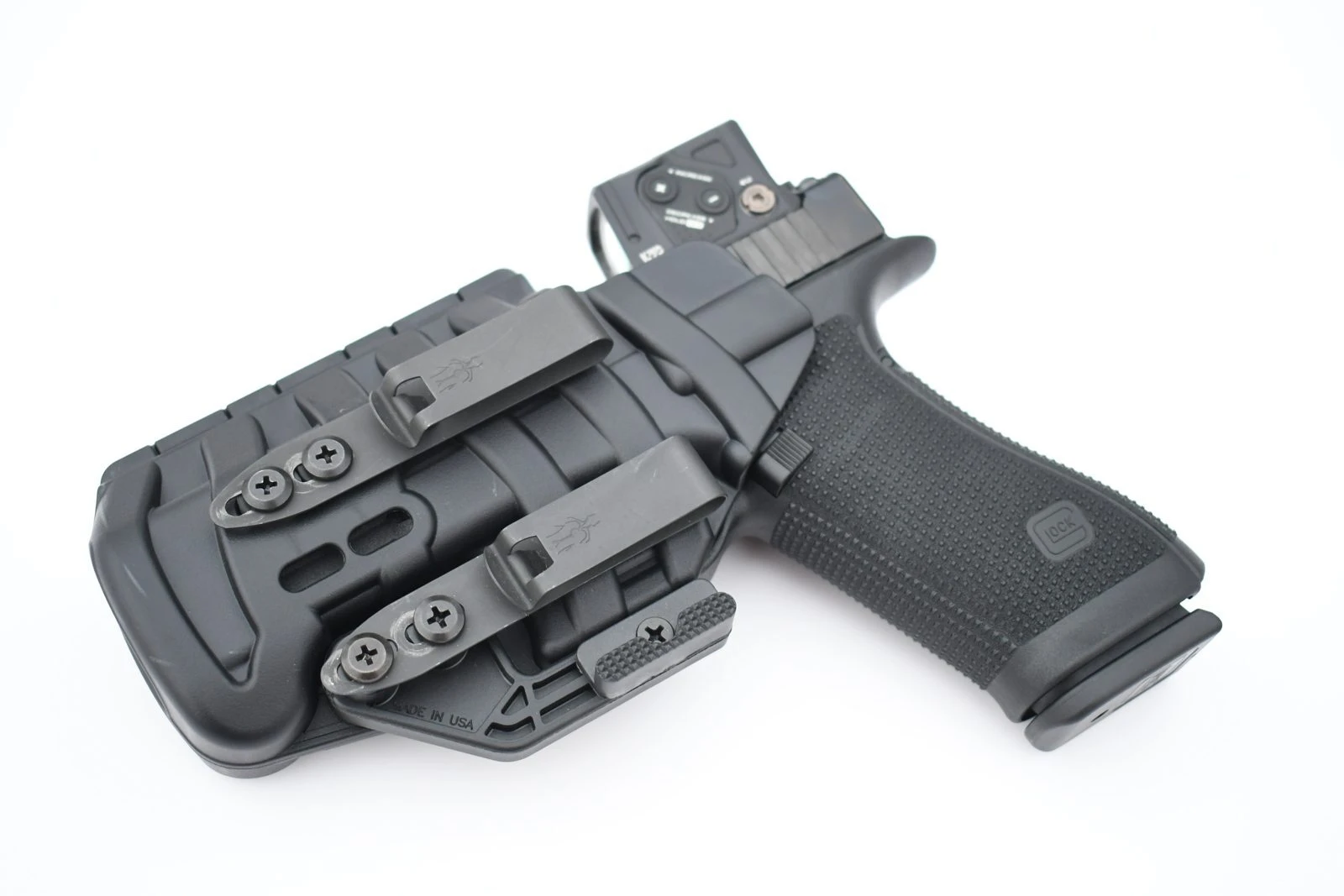
PHLster Classic
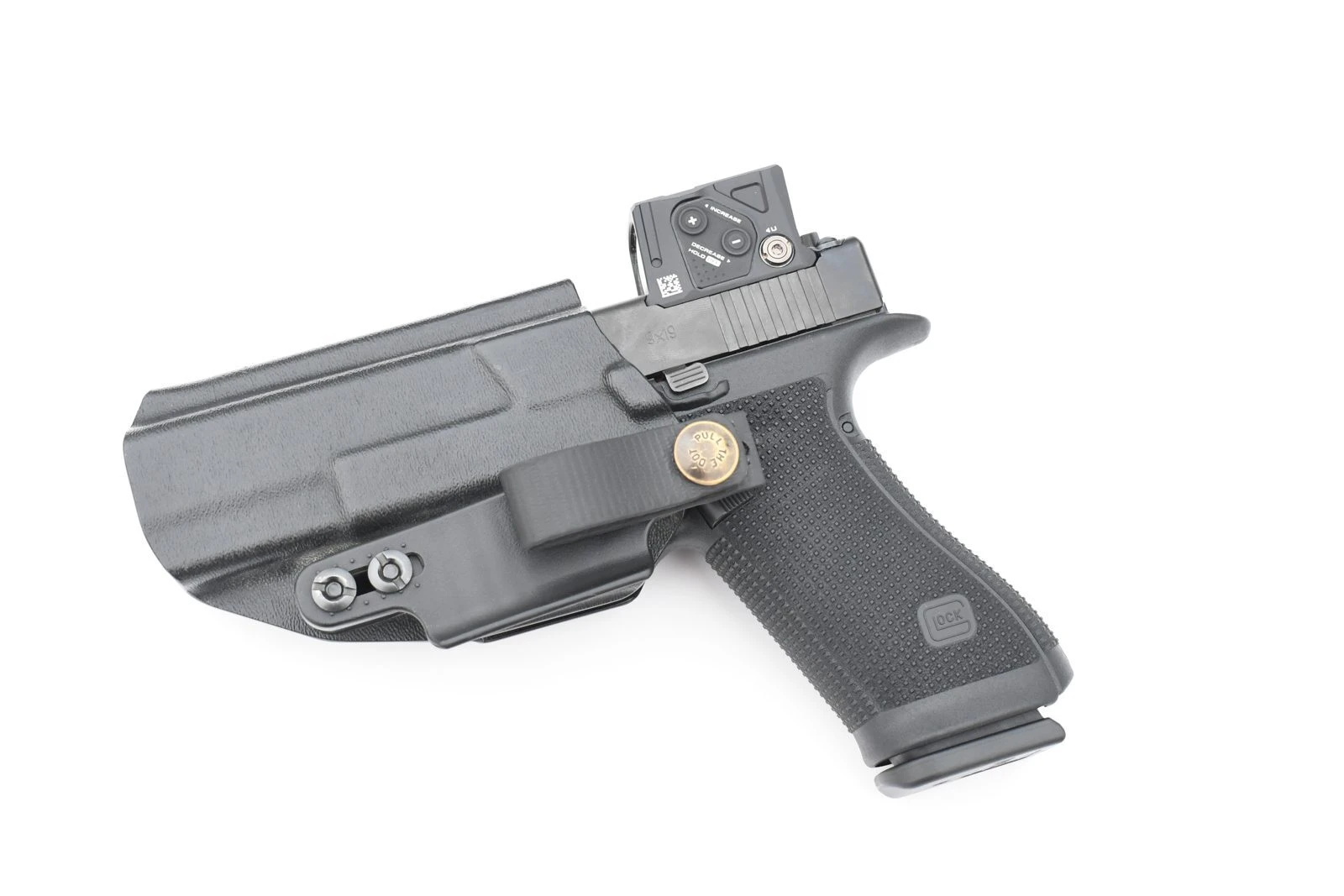
I tried my 2017 vintage PHLster Classic LH, from the very first batch of left-handed holsters that PHLster ever sold. This was also the first PHLster product I ever purchased. My old PHLster Classic has now been supporting my Glocks through three different generations–from my Gen4 Glock 34 I used to carry up to today, with my latest Glock 17. It’s still going strong and still works as fine as it ever has with Glock’s latest crop. Even after countless draws and time on my belt, the new pistols still snap into the PHLster Classic’s built-in retention around its trigger guard.
PHLster Pro
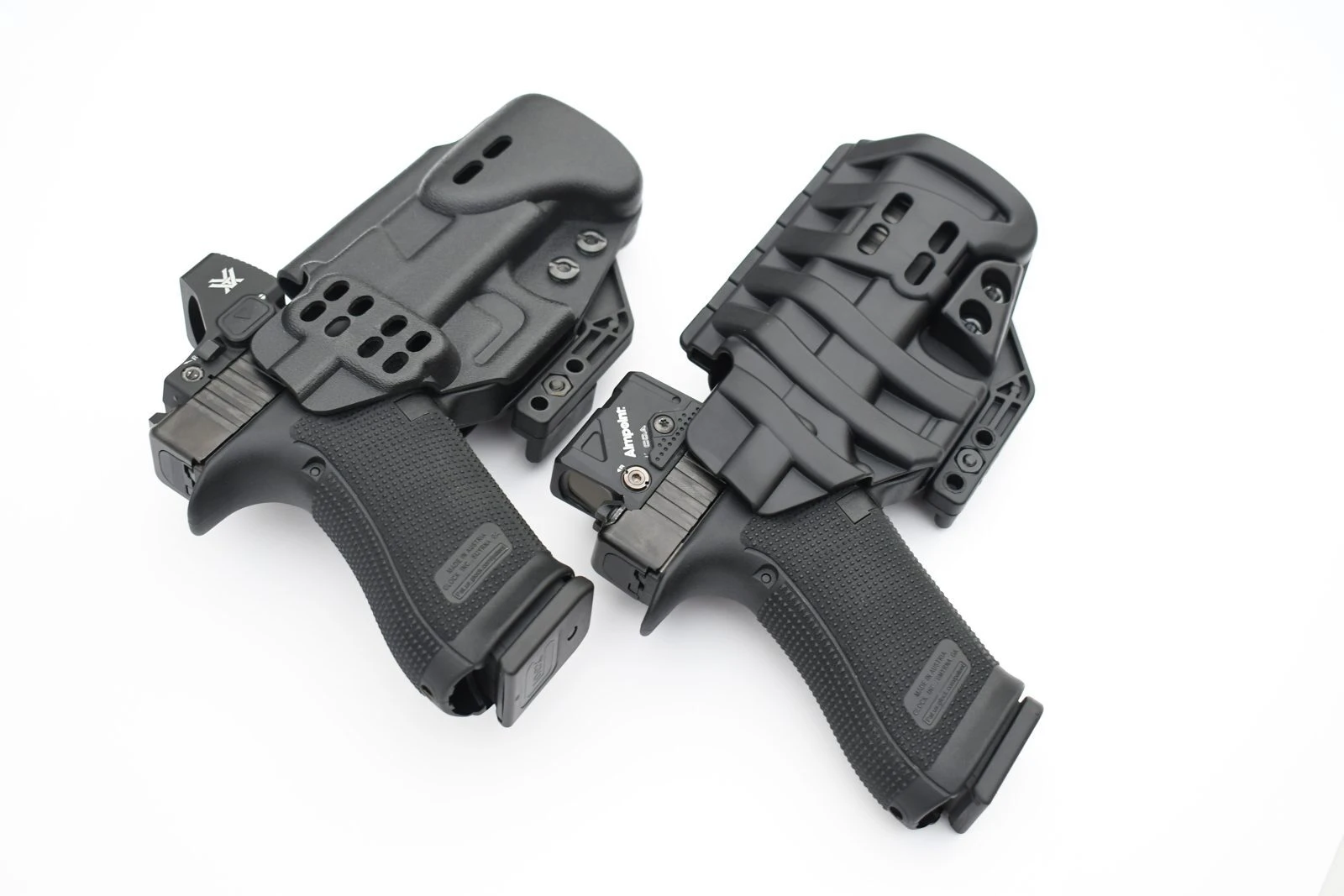
I’ve also got a PHLster Pro holster. Even though I don’t have as much time with this holster as I do with that original left handed Classic, the Pro is a newer design that has been a longstanding item on the catalog–always available for Glock’s most popular models. As expected, neither Gen6 model gave me any issues. In fact, as I write this, I am currently carrying that Glock 45 COA with it.
PHLster ProV2
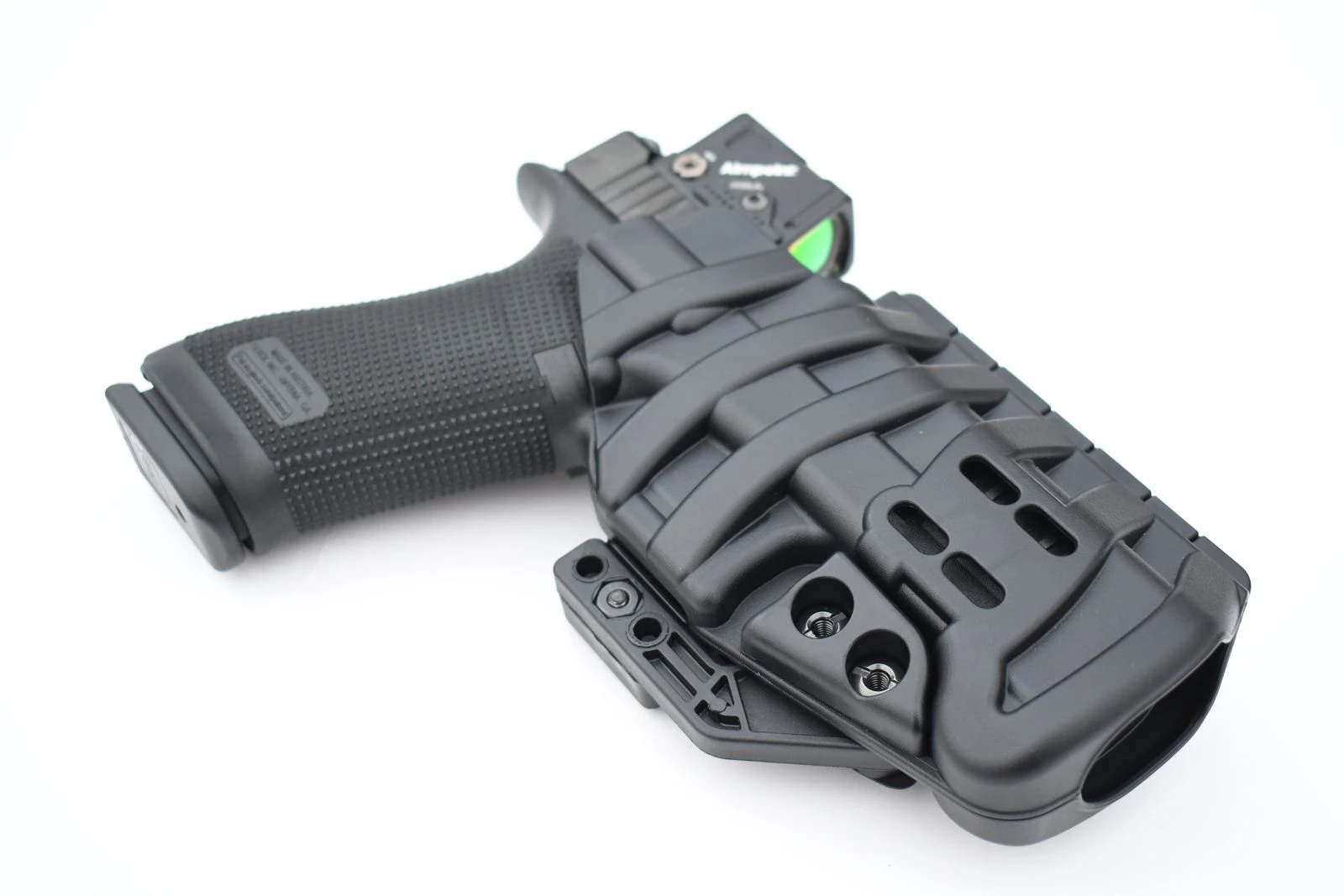
Speaking of new designs, PHLster just announced its latest version of the Pro, the new ProV2. This new design incorporates a ComfortScape design on its exterior. As far as compatibility, I’ve got nothing different to add. The pistols snap into place smartly the way PHLster holsters were intended to do so. And since this is brand new, I also dug out my Ruger RXM and Glock 47 to try with the new ProV2. Carry with confidence.
Summary Of Generational Changes
Glock Gen6 Frame
- New Glock RTF-6 Grip texture that covers more surface area on left and right sides of grip
- Re-contoured grip profile that does away with the previous “boxiness” and fits a wider range of hand shapes
- New grip has a subtle palm swell that tapers toward magazine well area
- More aggressive undercut on trigger guard to reduce “Glock-knuckle”
- Includes a ½ inch long beavertail to prevent slide bite for those with larger hands
- Forward on the frame, Gen6 frames have molded and textured ledges for thumbs. Many are calling these “gas pedals” but I semantically disagree. They’re more akin to shelves for a thumbs-forward firing grip.
- New flat-faced trigger shoe
- Forward edge of the magazine release button is rounded instead of square
Glock Gen6 Slide
- Return to Gen3 style simple 18# recoil spring assembly (P/N 5593)
- Front and rear slide serrations are deeper
- Glock’s Optic Ready System for mounting now standard across the new generation; all Gen6 pistols are inherently optics-ready
- Gen6 slide internals are redesigned to prevent interference from optics screws poking too far down, includes external extractor assembly
- Rear of the Gen6 slide also has different geometry to dissuade illegal use of so-called “switches” similar to Gen5 style “V” models.
Stepped Chambers, New In Glock’s Universe
Barrels on Gen6 models have stepped chambers. I previously missed this detail and hadn’t noticed until I brought my own Gen6 Glock 17 to the range and gathered brass. Stepped chambers are a very German engineering implementation. They’re commonly found on Walther and HK’s offerings. Anecdotally, I’ve shot thousands of 9mm (both reloads or factory) through pistols with stepped chambers without issue.
The purpose of stepped chambers is to provide a tighter seal between the mouth of the cartridge and the chamber itself. Though the tolerances around the “stepped” portion are very fine, its other purpose is to index the cartridge more concentrically as it sits in the chamber for better alignment.
Optics First
One of the new generational changes for the new Glocks was the switch from the Glock MOS to the new Gen6 Optic Ready System. Instead of relying on the traditional adapter plate, Gen6 slides are already pre-drilled to accommodate the typical range of optic screws (eg #6-32, M3, M4, et cetera). Since these screw holes are already present on the slide surface, Glock includes polymer shims that not only “fill the gaps” but accommodate the footprint of each respective optic. Each Gen6 model includes 3 shims (Trijicon RMR, Leupold DeltaPoint Pro and C-More). Naturally, the first thing I did when I got home was to mount my Vortex Defender XL 5 MOA red-dot with the DeltaPoint Pro shim.
During that press event, Glock mentioned that they determined that a polymer shim worked better than a metal unit due to the manner in which the polymer material compressed between the screws and the slide’s cut-out. So mounting this Vortex Defender XL with the OEM shim has been a great chance to see how it shakes out in real life.
There is some discussion as to the real-world efficacy of the long-term viability of the OEM shims. At the time I write this, a handful of brands are also offering aftermarket metal shims and plates. While I have not logged an inane number of rounds through my Gen6 Glock 17 specimen, I have not experienced any glaring issues within the first 500 or so rounds. I don’t currently feel any compunction to replace the OEM solution.
The Gen6 Experience
In the hand, this “new” gun is unmistakably a Glock, albeit with an improved grip and texture. Some love this and others probably hate it. I don’t mind it because I’ve determined through experience that I get along well with full-size Glock pistols. It’s also one of the reasons I’ve carried them for a long time.
Articulating recoil impulse by written word is always tricky as it’s subjective. With standard ammo, I find that the Gen6 Glock 17 and its 18# RSA offers a good balance between slide reciprocation, snappiness and impulse. It’s neither too snappy nor too slow. When paired with a decent red-dot, it’s easy to visually track during spirited splits.
Besides shooting the gun in USPSA Carry Optics*, I fired a 7-yard Dot Torture drill for the sake of this review. Shooting Dot Torture successfully involves a consistent approach to every trigger pull. I’ve found that the required methodical slowness is a great way to “get to know” a new handgun. This time, I ended up with a score of 47/50. I dropped two shots on #8, arguably the hardest portion of this drill. Unfortunately, due to carelessness and a focus shift, I dropped my last shot on #10 too.
My favorite aspect about this new pistol is its re-contoured grip. There’s no surprise why people have been paying lots of money for high-quality grip profiling and stipple jobs from outfits like Boresight Solutions over the years.
Thoughts On The Trigger
I’m not crazy about the Gen6’s trigger. Perhaps I’m neutral at best. The flattened shoe doesn’t do anything for me, and given my experience, I prefer the way Gen5 stock triggers break.
Superlative shooting with this pistol does require pro-active trigger management. The new trigger feels like it will smoothen out with use and wear, and I wish the trigger’s breaking point to the wall was slightly shorter; likewise, it would be nice if the break itself took a tad less pressure. Perhaps this will improve over time as it wears.
Using my electronic trigger-pull scale, 10 trigger pulls averaged to 5 lbs, 8 ounces.
The pistol itself offers plenty of mechanical accuracy, but I suspect that the bottleneck for most people lies in trigger management.
Fixing or upgrading the Gen6 trigger won’t be hard. As I write this review, I’m already seeing evidence of shooters experimenting with alternative trigger modules and aftermarket units.
All things considered, the Gen6 stock trigger is adequate for duty and defense. Truthfully, stock Glock pistols have never been known for their out-of-the-box triggers, but my specimen also printed a weighted average of 2.11 inch 25-yard groups on its maiden voyage to the range. I shot the pistol off a bag, not a mechanical rest.
Although this review is about a mass produced pistol, it wasn’t long ago that shooting 2-inch groups at 25 yards was a massive benchmark for fancy custom pistols.
Accuracy Report
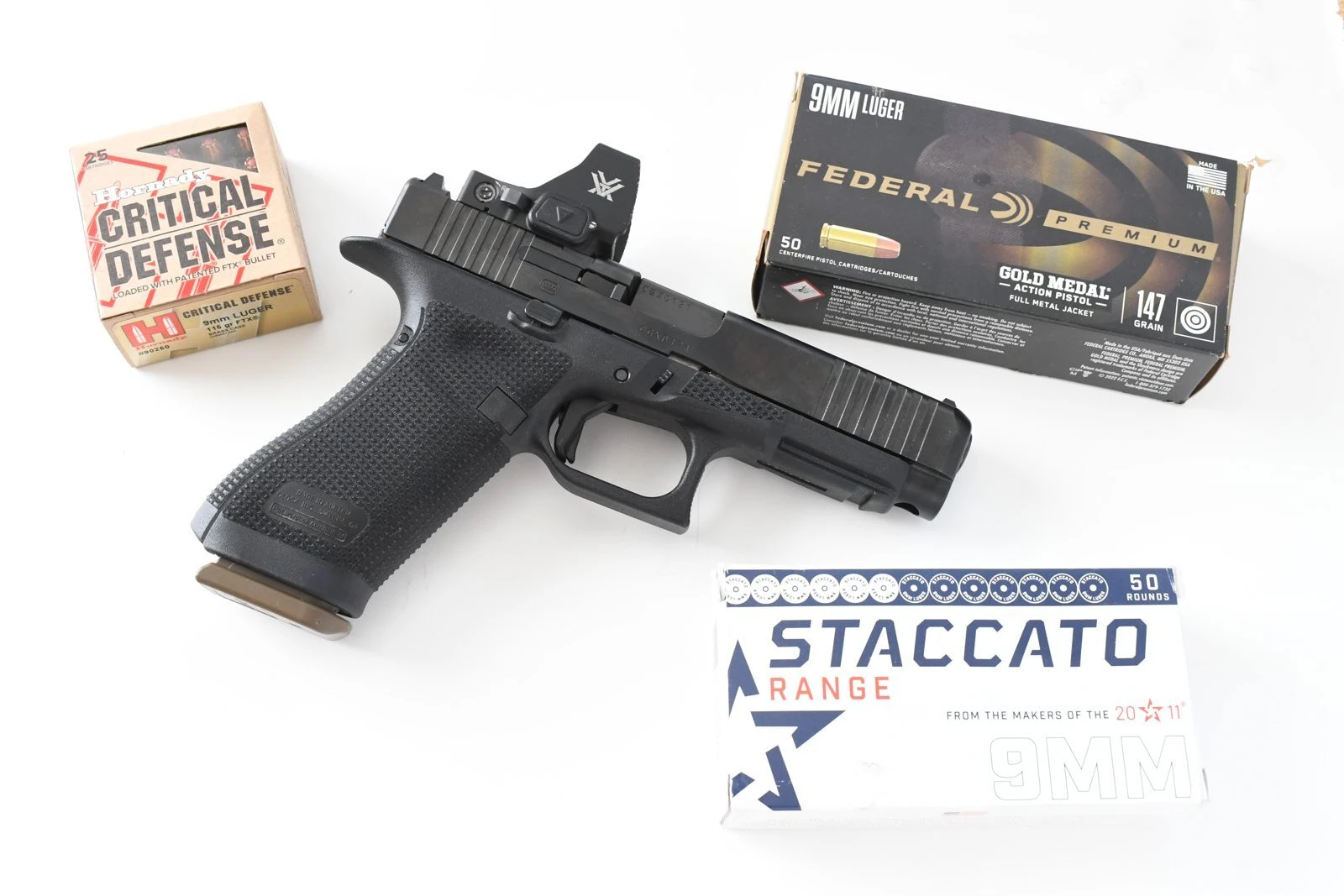
I fired different 9mm factory loads from a seated position using bag support at 25 yards. Ammunition brands used included Staccato’s 124-grain Range FMJ, Hornady’s Critical Defense 115-gr JHP and Federal Gold Medal 147-gr FP Action Pistol.
*Action-pistol shooters that prefer softer-recoiling competition ammunition will likely want to replace the stock RSA with a lighter unit for increased reliability.
25 Yard Results, 4 groups of 5 rounds each
| Ammo: 9mm | Muzzle Velocity, Std Dev, ES | Min Group (inches) | Avg Group | Max Group |
|---|---|---|---|---|
| Federal Gold Medal 147-gr FP | FPS: 847.7 StDev: 8.5 ES: 34.0 |
1.25 | 2.37 | 3.00 |
| Staccato Range 124-gr FMJ | FPS: 1125.0 StDev: 6.4 ES: 24.2 |
1.38 | 1.60 | 1.90 |
| Hornady Critical Defense 115-gr JHP | FPS: 1068.2 StDev: 6.1 ES: 27.7 |
1.90 | 2.38 | 2.90 |
Chronograph: Garmin Xero C2, at the muzzle. Temp 88° F. All FPS, StDev, ES come from a sample size of 20 rounds.