
Concealed Carry Without a Belt: Why a Regular Belt Under Your Clothes Might Not Be the Answer
Posted by Jon Hauptman on Aug 31st 2026
We'll always be the first to point it out: there are cheaper and simpler ways to carry a pistol with clothing that doesn't support a conventional belt than using the PHLster Enigma. In fact, these methods were what we, ourselves, used many years ago before the Enigma existed. The simplest, easiest way to accomplish this was to wear a regular belt under your clothing. Whether it was sweat pants, gym shorts, yoga pants, office attire, dresses, or anything else which either didn't have belt loops or was worn in environments where holster clips showing would be a problem.
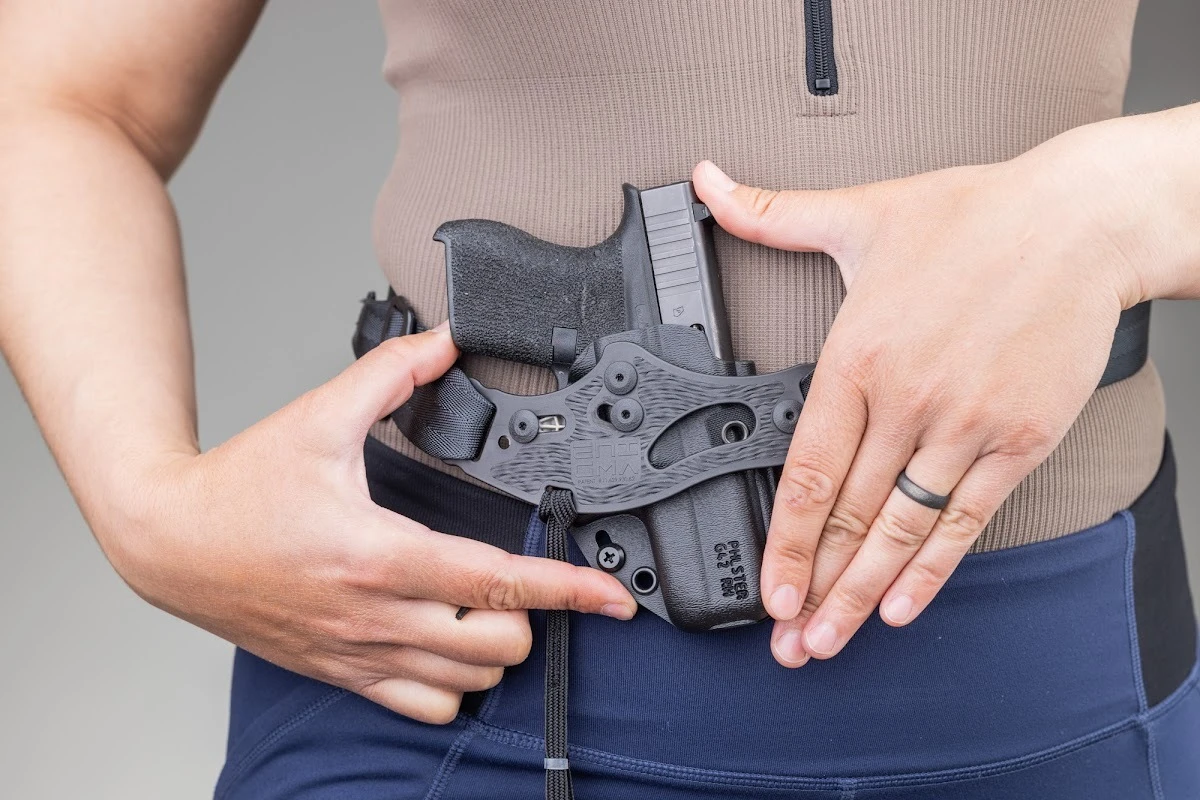
And in most cases, we found this performed better than elastic bellybands and similar products. However, through extensive experience and testing, we found that there were still a number of drawbacks.
What we learned the hard way
First and foremost, when we took our improvised "beltless" solutions to classes and competitions, they didn't perform as well as a belt that's attached to the pants. In self defense contexts which involved grappling, entanglements, ground-fighting, or fighting inside a vehicle, a belt underneath the clothing was not reliable. The vigorous movement and awkward body positions caused the gun and belt to move around, provide inconsistent access, and fouled draws.
Second, we noticed that many contexts which required wearing a belt under the clothing also required a much higher degree of concealment. We saw how the overall thickness of conventional holster belt clips, attached to a conventional belt under the clothing, worked against that goal by creating awkward bulges. The holster/clip/belt stack was just too thick.
And ultimately, a belt is made to fit your pants, not your body and definitely not a gun. The distance between the pistol grip and the belt always needs to provide enough grip clearance, even if it results in the pistol being top heavy. And belts are a uniform stiffness (even the ones with "stiff" sections are the same stiffness across the whole gun and holster), but that's not optimal for concealment. If the same belt stiffness is pushing on both the holster wing and the slide, it can wind up undoing some of the concealment you're trying to accomplish. This leads to over-tightening the belt, making carry less comfortable, and potentially even breaking holsters.
Designing from first principles
If we're going to design something to be worn under the clothes, without a regular carry belt, why on Earth would we make it shaped like a belt? It doesn't need to fit through pants belt loops or hold your pants up, anymore. When the product is free from those constraints, we can focus on how the pistol needs to balance in order to be comfortable and concealable. And we can focus on how the pistol conforms to the body. And which parts of this system need to be stiff, in order to provide concealment, which parts need to be curved to adjust the pistol's center of gravity, and which parts can be flexible in order to conform to the body. Once the design is free from the limitations of fitting pants, then we can focus on nothing other than the interaction between the gun and the body. There's nothing about a plain strap, the shape and size of which is determined by your pants, which has anything to do with concealing a pistol. When we look at this problem from first-principles, we can see immediately that the only reason we attach guns to belts is because the belt is convenient. Not because there's anything innate about the belt, other than its presence.
And from there, we took the lessons learned from training in high-intensity environments and carrying in high scrutiny contexts. We added a leg leash to help anchor the system in place, so no matter how awkward the position and no matter how much fighting had taken place prior to drawing the pistol, the system is right where you put it and the draw isn't fouled or inconsistent. And we eliminated the bulk of the clips by using the Enigma faceplate, which is dramatically more slim and lower profile than any holster belt clips, adding only a few millimeters of thickness to the holster itself.
In designing the Enigma, our focus was on developing the most invisible and most capable concealment system. Period. We threw away the limitations and compromises which come from attaching holsters to regular belts, and arrived at a solution which provides better-than-belt concealment, in any clothing, without any of the performance compromises.
The honest tradeoff
The Enigma absolutely does take more work to get it set up and dialed in, compared to putting a regular holster on a regular belt...at first.
What we've observed is that the experience of most concealed carriers disguises the amount of work to get good concealment by making that work happen over a long, expensive, and frustrating (albeit slow and incremental) amount of time. Most holsters will give you everything they have to offer, the moment you put them on. And so many people have spent years switching holsters, switching guns, and switching belts until it's been months or years and hundreds (or thousands) of dollars spent on gear to fit their different contexts and clothing. The Enigma is definitely more expensive than the first belt and holster you'll buy, when you start this process. But it's not as expensive as the first 6-12 months of concealed carry trial and error. And it's more time consuming to set up than your first holster, because it does more and getting the most out of it requires the knowledge and application of concealment fundamentals.
Start with the education, not the gear
Fortunately, we host the foremost industry-leading library of education on the topic. And you can start learning that material and putting it into practice with the gear you already have. You might never need or want a PHLster Enigma, but we're happy to be able to improve your concealed carry experience, no matter what you're carrying: explore the free education library.
For further viewing, check out our video on the history of beltless carry before we invented the Enigma.
And if you're on the fence about the Enigma, start here: 7 Reasons Not to Buy the PHLster Enigma.
About the author: Jon Hauptman, owner of PHLster. 15 years of holster making and design experience.